>
Perciformes/Zoarcoidei (Eelpouts and pricklebacks) >
Zoarcidae (Eelpouts) > Lycodinae
Etymology: Lycodes: Greek, lykos = wolf + Greek, suffix, oides = similar to (Ref. 45335); diapterus: From the Greek di and apteros meaning 'two' and 'fin' (Ref. 27436).
More on author: Gilbert.
पर्यावरण: पर्यावरण / जलवायु क्षेत्र / गहराई सीमा / वितरण सीमा
पारिस्थितिकी
समुद्री बाथीड़िमरसल; गहराई सीमा 146 - 844 m (Ref. 80505), usually 300 - 600 m (Ref. 80505). Deep-water
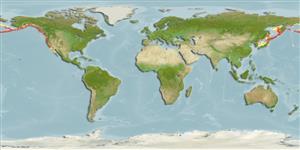
North Pacific: Southern California west of the Channel Islands north along the North American coast to the Pacific side of Vancouver Island; apparently not present in the Strait of Georgia or Puget Sound, and has been reported as far south as San Diego.
आकार / वज़न / आयु
परिपक्व अवधि: Lm ? range ? - ? cm
Max length : 33.0 cm TL पुल्लिंग / अलिंग; (Ref. 2850)
पृष्ठीय रीढ़ (सम्पूर्ण) : 0; पृष्ठीय सौफट रेज़ (सम्पूर्ण) : 109 - 118; गुदा कांटा: 0; ऐनल सौफट रेज़: 99 - 109; जानवरों की रीड़ का जोड़: 118 - 126. This species is distinguished by the following: with scales covering the nape and the entire postorbital dorsal surface of the head (in adults 15.0 cm SL and larger): it differs from L. beringi in having higher counts of dorsal-fin ray (usually 111 or more), anal-fin ray (usually 100 or more), vertebral (usually 119 or more), and gill raker (usually 15 or more); differs from L. hubbsi in having 19-21 pectoral-fin rays (vs. 20-23), position of the first dorsal-fin
pterygiophore at the sixth or seventh interneural gap (vs. third), and color pattern, for it lacks narrow light bands extending onto dorsal fin and across nape; differs from the 'L. nakamurae group’’ (nakamurae, pectoralis, nishimurai) in having 4 postorbital pores (vs. 1 or 2), the posteriormost without a short tube; lower pectoral-fin lobe rounded, the tips of the rays rounded and the middle rays often branched, fin membrane not incised (vs. pointed, with rays pointed and unbranched, membrane moderately incised); scales often present on base of pectoral fin; light inverted V-shaped bands usually present on body (Ref. 80505).
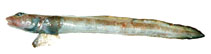
Body shape (shape guide): eel-like; Cross section: oval.
Found on muddy bottoms (Ref. 2850). May be used as bait (Ref. 27436). Flesh considered firm and tasty but not esteemed (Ref. 27436).
जीवन चक्र और संभोग व्यवहार
परिपक्व अवधि | पुनरुत्पत्ति | मछलीऔ का अंडे देना | अंडे | उपजाऊपन | लार्वा
Anderson, M.E., 1994. Systematics and osteology of the Zoarcidae (Teleostei: Perciformes). Ichthyol. Bull. J.L.B. Smith Inst. Ichthyol. 60:120 p. (Ref. 11954)
आईयूसीएन रेड लिस्ट स्थिति (Ref. 130435: Version 2025-2 (Global))
मनुष्यों के लिए ख़तरा
Harmless
मानव उपयोग
मात्स्यिकी: निर्वाह मात्स्यिकी
साधन
विशेष रिपोर्ट
XML डाउनलोड करें
इंटरनेट स्रोत
मॉडल पर आधारित अनुमान
पसंदीदा तापमान (संदर्भ
123201): 0.8 - 5.4, mean 3.2 °C (based on 128 cells).
जातिवृति विविधता सूचकांक (संदर्भ
82804): PD
50 = 0.5000 [Uniqueness, from 0.5 = low to 2.0 = high].
Bayesian length-weight: a=0.00120 (0.00057 - 0.00253), b=3.10 (2.91 - 3.29), in cm total length, based on LWR estimates for this (Sub)family-body shape (Ref.
93245).
ट्रॉफिक स्तर (संदर्भ
69278): 3.4 ±0.4 se; based on size and trophs of closest relatives
लौटाव (संदर्भ
120179): निम्न, न्यूनतम जनसंख्या दुगनी होने का समय 4.5 - 14 वर्ष। (Preliminary K or Fecundity.).
मछली पकड़ने की भेद्यता (Ref.
59153): Low vulnerability (23 of 100).
🛈