>
Beloniformes (Needle fishes) >
Hemiramphidae (Halfbeaks)
Etymology: Hyporhamphus: Greek, hypo = under + Greek, rhamphos = beak, bill (Ref. 45335).
Eponymy: Rosa Smith Eigenmann (1858–1947) was the wife of ichthyologist Carl H Eigenmann and an ichthyologist in her own right. [...] (Ref. 128868), visit book page.
More on authors: Jordan & Gilbert.
Umwelt: Milieu / Klimazone / Tiefenbereich / Verbreitungsgebiet
Ökologie
seewasser; süßwasser; brackwasser pelagic-neritic; tiefenbereich 0 - ? m. Subtropical
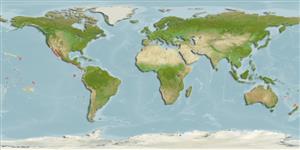
Eastern Pacific: Santa Ana in southern California, USA to Costa Rica. Range extends to Panama (Ref. 36576). Reported from Peru and Galapagos Islands (Ref. 5530).
Größe / Gewicht / Alter
Geschlechtsreife: Lm ? range ? - ? cm
Max length : 15.0 cm TL Männchen/unbestimmt; (Ref. 2850); common length : 9.0 cm SL Männchen/unbestimmt; (Ref. 9306)
Kurzbeschreibung
Bestimmungsschlüssel | Morphologie | Morphometrie
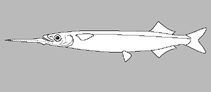
Rückenflossenstacheln (insgesamt) : 0; Rückenflossenweichstrahlen (insgesamt) : 13 - 15; Afterflossenstacheln: 0; Afterflossenweichstrahlen: 14 - 16; Wirbelzahl: 47 - 50. Branchiostegal rays: 10-12 (Ref. 36576).
Adults are found near shore, frequently in coastal bays at or near the surface. Often form small schools. Occasionally penetrate fresh waters (Ref. 9306). Presumably oviparous, with planktonic larvae (Ref. 36576). Eggs are attached to spawning substrate via filaments (Ref. 36576).
Lebenszyklus und Paarungsverhalten
Geschlechtsreife | Fortpflanzung | Ablaichen | Eier | Fruchtbarkeit | Larven
Eschmeyer, W.N., E.S. Herald and H. Hammann, 1983. A field guide to Pacific coast fishes of North America. Boston (MA, USA): Houghton Mifflin Company. xii+336 p. (Ref. 2850)
IUCN Rote Liste Status (Ref. 130435: Version 2025-2 (Global))
Bedrohung für Menschen
Harmless
Nutzung durch Menschen
Tools
Zusatzinformationen
Download XML
Internet Quellen
Schätzungen auf der Grundlage von Modellen
Bevorzugte Temperatur (Ref.
123201): 17.4 - 28.3, mean 23.4 °C (based on 64 cells).
Phylogenetischer Diversitätsindex (Ref.
82804): PD
50 = 0.5000 [Uniqueness, from 0.5 = low to 2.0 = high].
Bayesian length-weight: a=0.00257 (0.00116 - 0.00571), b=3.09 (2.92 - 3.26), in cm total length, based on LWR estimates for this Genus-body shape (Ref.
93245).
Trophische Ebene (Ref.
69278): 3.0 ±0.4 se; based on size and trophs of closest relatives
Widerstandsfähigkeit (Ref.
120179): hoch, Verdopplung der Population dauert weniger als 15 Monate. (Preliminary K or Fecundity.).
Anfälligkeit der Fischerei (Ref.
59153): Low vulnerability (10 of 100).
🛈