>
Gadiformes (Cods) >
Gadidae (Cods and haddocks)
Etymology: Microgadus: Greek, mikros = samll + Latin, gadus = a fish, cod? (Ref. 45335).
More on author: Walbaum.
Entorno: milieu / zona climática / rango de profundidad / gama de distribución
Ecología
marino; agua dulce; salobre demersal; anadromo (Ref. 26213); rango de profundidad 0 - 69 m (Ref. 57178). Temperate; 54°N - 36°N, 76°W - 56°W (Ref. 86798)
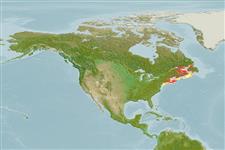
Northwest Atlantic: southern Labrador in Canada to Virginia in USA.
Tamaño / Peso / Edad
Madurez: Lm ? range ? - ? cm
Max length : 38.1 cm TL macho / no sexado; (Ref. 5951)
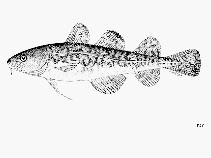
Espinas dorsales (total) : 0; Espinas anales: 0. Body elongated; head small; eyes relatively small. Pelvic fins with a slightly elongated filament. Olive green brown or yellow dorsally, paler ventrally; with dark mottling on sides and fins.
Body shape (shape guide): elongated; Cross section: circular.
Adults are found in coastal, brackish and fresh water, landlocked in several lakes. They feed mostly on small crustaceans, (especially shrimps and amphipods); also worms, small mollusks, squids and fishes (smelt, sticklebacks, striped bass, alewives, shed, herring and sculpins (Ref.. 5951,1371).
Ciclo vital y comportamiento de apareamiento
Madurez | Reproducción | Puesta | Huevos | Fecundidad | Larva
Oviparous, sexes are separate (Ref. 205).
Cohen, D.M., T. Inada, T. Iwamoto and N. Scialabba, 1990. FAO species catalogue. Vol. 10. Gadiform fishes of the world (Order Gadiformes). An annotated and illustrated catalogue of cods, hakes, grenadiers and other gadiform fishes known to date. FAO Fish. Synop. 125(10). Rome: FAO. 442 p. (Ref. 1371)
Situación en la Lista Roja de la UICN (Ref. 130435: Version 2025-2 (Global))
Amenaza para el ser humano
Harmless
Usos humanos
Pesquerías: escaso valor comercial; pesca deportiva: si
Herramientas
Informes especiales
Descargar XML
Fuentes de Internet
Estimaciones basadas en modelos
Temperatura preferida (Referencia
123201): 2.7 - 12.6, mean 6.4 °C (based on 144 cells).
Índice de diversidad filogenética (Referencia
82804): PD
50 = 0.7500 [Uniqueness, from 0.5 = low to 2.0 = high].
Bayesian length-weight: a=0.00398 (0.00191 - 0.00831), b=3.13 (2.94 - 3.32), in cm total length, based on LWR estimates for this (Sub)family-body shape (Ref.
93245).
Nivel trófico (Referencia
69278): 3.8 ±0.50 se; based on food items.
Resiliencia (Referencia
120179): Medio, población duplicada en un tiempo mínimo de 1.4-4.4 años (Assuming tm=2-4).
Vulnerabilidad pesquera (Ref.
59153): Low to moderate vulnerability (28 of 100).
🛈
Vulnerabilidad climática (Ref.
125649): High to very high vulnerability (75 of 100).
🛈
Nutrientes (Ref.
124155): Calcium = 48 [26, 98] mg/100g; Iron = 0.354 [0.195, 0.622] mg/100g; Protein = 17.7 [16.4, 19.1] %; Omega3 = 0.414 [0.202, 0.847] g/100g; Selenium = 11.7 [5.8, 26.8] μg/100g; VitaminA = 13.4 [3.7, 47.0] μg/100g; Zinc = 0.656 [0.458, 0.956] mg/100g (wet weight);