>
Gadiformes (Cods) >
Gadidae (Cods and haddocks)
Etymology: Micromesistius: Greek, mikros = small + greek, mesos = middle + Greek, istion = sail (Ref. 45335).
More on author: Norman.
Entorno: milieu / zona climática / rango de profundidad / gama de distribución
Ecología
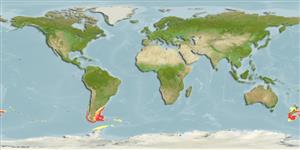
marino bentopelágico; oceanodromo (Ref. 51243); rango de profundidad 50 - 900 m (Ref. 27363), usually 200 - 400 m (Ref. 7061). Temperate; 37°S - 65°S, 165°E - 34°W (Ref. 54589)
There are 2 disjunct populations. Micromesistius australis australis occurs around the Falkland Islands and Argentine Patagonia in the southwest Atlantic; off Chile in the southeast Pacific; also off South Georgia, South Shetland and South Orkney islands. Micromesistius australis pallidus occurs around the South Island of New Zealand.
Longitud en la primera madurez / Tamaño / Peso / Edad
Madurez: Lm 33.7, range 33 - 40 cm
Max length : 90.0 cm TL macho / no sexado; (Ref. 1371); common length : 60.0 cm TL macho / no sexado; (Ref. 1371); peso máximo publicado: 850.00 g (Ref. 4883); edad máxima reportada: 30 años (Ref. 7059)
Espinas dorsales (total) : 0; Radios blandos dorsales (total) : 43 - 55; Espinas anales: 0; Radios blandos anales: 56 - 71; Vértebra: 54 - 57.
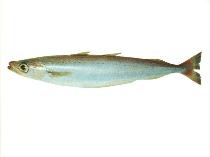
Body shape (shape guide): elongated; Cross section: circular.
Invades shelf waters during summer and concentrating over the continental slope in winter. Forms schools (Ref. 9072). The young feed on euphausiids and amphipods and occasionally on copepods, cephalopods and small fish. Utilized in frozen blocks and as fishmeal. In Japan used as suerii (minced meat) for karaoke (fish cake) (Ref. 27363). Can be fried, microwaved and baked (Ref. 9988).
Oviparous, sexes are separate (Ref. 205).
Cohen, D.M., T. Inada, T. Iwamoto and N. Scialabba, 1990. FAO species catalogue. Vol. 10. Gadiform fishes of the world (Order Gadiformes). An annotated and illustrated catalogue of cods, hakes, grenadiers and other gadiform fishes known to date. FAO Fish. Synop. 125(10). Rome: FAO. 442 p. (Ref. 1371)
Situación en la Lista Roja de la UICN (Ref. 130435: Version 2025-2 (Global))
Amenaza para el ser humano
Harmless
Usos humanos
Pesquerías: muy comercial
Herramientas
Informes especiales
Descargar XML
Fuentes de Internet
Estimaciones basadas en modelos
Temperatura preferida (Referencia
123201): 3.4 - 9.1, mean 5.8 °C (based on 109 cells).
Índice de diversidad filogenética (Referencia
82804): PD
50 = 0.7500 [Uniqueness, from 0.5 = low to 2.0 = high].
Bayesian length-weight: a=0.00372 (0.00224 - 0.00616), b=3.15 (3.00 - 3.30), in cm total length, based on LWR estimates for this species & (Sub)family-body (Ref.
93245).
Nivel trófico (Referencia
69278): 3.8 ±0.50 se; based on food items.
Resiliencia (Referencia
120179): Medio, población duplicada en un tiempo mínimo de 1.4-4.4 años (K=0.18; tm=2-5; tmax=30).
Prior r = 0.54, 95% CL = 0.36 - 0.82, Based on 5 data-limited stock assessments.
Vulnerabilidad pesquera (Ref.
59153): Moderate to high vulnerability (52 of 100).
🛈
Vulnerabilidad climática (Ref.
125649): Moderate to high vulnerability (53 of 100).
🛈
Nutrientes (Ref.
124155): Calcium = 38.2 [10.7, 99.6] mg/100g; Iron = 0.368 [0.123, 1.121] mg/100g; Protein = 16.3 [14.4, 18.6] %; Omega3 = 0.381 [0.149, 0.940] g/100g; Selenium = 12.1 [3.0, 42.1] μg/100g; VitaminA = 9.29 [1.98, 46.46] μg/100g; Zinc = 0.673 [0.286, 1.563] mg/100g (wet weight); based on
nutrient studies.