>
Gadiformes (Cods) >
Merlucciidae (Merluccid hakes)
Etymology: Merluccius: Latin, mar, maris = the sea + Latin, lucius = pike (Ref. 45335).
Taxonomic Remarks
Reported as M. polylepis in Patagonian waters.
Entorno: milieu / zona climática / rango de profundidad / gama de distribución
Ecología
marino bentopelágico; oceanodromo (Ref. 51243); rango de profundidad 28 - 1000 m (Ref. 58489). Subtropical; 33°S - 59°S, 165°E - 66°W (Ref. 58452)
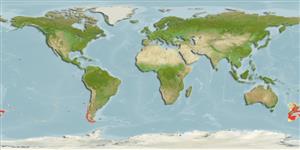
Circumglobal in the southern hemisphere (Ref. 7300). Two distinct groups. New Zealand population: Chatham Rise, Campbell Plateau and South Island northward to the East Cape. Patagonian population: Chiloé Island in the Pacific, southward around the southern tip of South America to the continental shelf to 59°S, and the slope north to 38°S in the Atlantic.
Longitud en la primera madurez / Tamaño / Peso / Edad
Madurez: Lm 74.7, range 75 - 85 cm
Max length : 155 cm SL macho / no sexado; (Ref. 58452); common length : 80.0 cm TL macho / no sexado; (Ref. 1371); edad máxima reportada: 30 años (Ref. 9072)
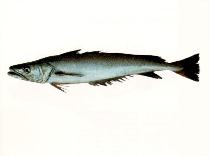
Espinas dorsales (total) : 1; Radios blandos dorsales (total) : 48 - 57; Espinas anales: 0; Radios blandos anales: 40 - 46; Vértebra: 53 - 58. Body more slender than other hakes. Pectoral fins long and slender, stripe reaching anal fin in young individuals but not in fish over 50 cm in SL. Gill rakers short and thick with blunt tips. Color is steel gray on back grading to silvery white ventrally.
Body shape (shape guide): elongated; Cross section: oval.
Found at depths between 415 and 1000 m in New Zealand waters, and 62 to 800 m in South American waters. The Patagonian population feeds on southern blue whiting, whiptail, nototheniids and squids. The New Zealand population feeds mainly on fishes (especially gadoids), squids, euphausiids and benthic organisms. Adults probably migrate southward during the southern summer for feeding and return to the north in winter for spawning (Ref. 1371). Spawning takes place from August to September on the western coast of South Island, from September to November in the northern part of the Campbell Plateau, and between November and January on Chatham Rise (Ref. 58452). Utilized as food fish and fishmeal.
Ciclo vital y comportamiento de apareamiento
Madurez | Reproducción | Puesta | Huevos | Fecundidad | Larva
Cohen, D.M., T. Inada, T. Iwamoto and N. Scialabba, 1990. FAO species catalogue. Vol. 10. Gadiform fishes of the world (Order Gadiformes). An annotated and illustrated catalogue of cods, hakes, grenadiers and other gadiform fishes known to date. FAO Fish. Synop. 125(10). Rome: FAO. 442 p. (Ref. 1371)
Situación en la Lista Roja de la UICN (Ref. 130435: Version 2025-2 (Global))
Amenaza para el ser humano
Harmless
Usos humanos
Pesquerías: muy comercial
Herramientas
Informes especiales
Descargar XML
Fuentes de Internet
Estimaciones basadas en modelos
Temperatura preferida (Referencia
123201): 6.2 - 13.3, mean 8.6 °C (based on 112 cells).
Índice de diversidad filogenética (Referencia
82804): PD
50 = 0.5000 [Uniqueness, from 0.5 = low to 2.0 = high].
Bayesian length-weight: a=0.00398 (0.00331 - 0.00479), b=3.10 (3.05 - 3.15), in cm total length, based on LWR estimates for this species (Ref.
93245).
Nivel trófico (Referencia
69278): 4.3 ±0.74 se; based on food items.
Generation time: 5.7 (4.2 - 10.7) years. Estimated as median ln(3)/K based on 15
growth studies.
Resiliencia (Referencia
120179): Bajo, población duplicada en un tiempo mínimo de 4.5-14 años (K=0.07-0.19; tm=6-10; tmax=30).
Prior r = 0.24, 95% CL = 0.16 - 0.35, Based on 4 full stock assessments.
Vulnerabilidad pesquera (Ref.
59153): High vulnerability (56 of 100).
🛈
Vulnerabilidad climática (Ref.
125649): High vulnerability (61 of 100).
🛈
Nutrientes (Ref.
124155): Calcium = 14.6 [5.9, 47.3] mg/100g; Iron = 0.536 [0.198, 1.332] mg/100g; Protein = 17.9 [16.7, 19.0] %; Omega3 = 0.148 [0.083, 0.263] g/100g; Selenium = 84.2 [34.5, 207.6] μg/100g; VitaminA = 11.5 [3.1, 40.8] μg/100g; Zinc = 0.314 [0.198, 0.493] mg/100g (wet weight); based on
nutrient studies.