>
Atheriniformes (Silversides) >
Atherinopsidae (Neotropical silversides) > Atherinopsinae
Etymology: Leuresthes: Greek, leyros, -a, -on = smooth + Greek, esthes = suit, something used to wrap (Ref. 45335).
More on author: Ayres.
Environnement : milieu / zone climatique / profondeur / gamme de distribution
Écologie
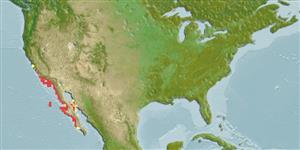
marin pelagic-neritic; profondeur 0 - 18 m (Ref. 2850). Subtropical; 37°N - 24°N, 123°W - 111°W
Eastern Pacific: Monterey Bay, USA to Baja California Sur, Mexico.
Longueur à la première maturité / Taille / Poids / Âge
Maturité: Lm 11.9 range ? - ? cm
Max length : 19.0 cm TL mâle / non sexé; (Ref. 2850); âge max. reporté: 8 années (Ref. 1744)
Description synthétique
Clés d'identification | Morphologie | Morphométrie
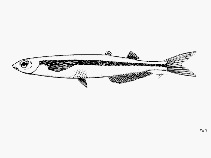
Épines dorsales (Total) : 4 - 8; Rayons mous dorsaux (Total) : 8 - 10; Épines anales: 1; Rayons mous anaux: 20 - 24; Vertèbres: 47 - 50. Branchiostegal rays: 6 (Ref. 36497).
Body shape (shape guide): elongated.
Adults inhabit inshore waters, usually at or near surface along open coast and in bays (Ref. 36497). Oviparous, with planktonic primarily neustonic larvae (Ref. 36497). Eggs are deposited in the sand at night by the female parent (Ref. 58332) just below the high spring tide line (Ref. 36497). Minimum depth reported taken from Ref. 57178.
Demersal spawners. Spawn at night on sand beaches at high tides in the spring and summer. Eggs are buried in moist sand by the female parent (Ref. 58332) and hatch about 15 days later during the next series of high tides (Ref. 2850). Females spawn 4 to 8 times during a season (Ref. 4563).
Eschmeyer, W.N., E.S. Herald and H. Hammann, 1983. A field guide to Pacific coast fishes of North America. Boston (MA, USA): Houghton Mifflin Company. xii+336 p. (Ref. 2850)
Statut dans la liste rouge de l'IUCN (Ref. 130435: Version 2025-2 (Global))
Menace pour l'homme
Harmless
Utilisations par l'homme
Pêcheries: intérêt commercial mineur
Outils
Articles particuliers
Télécharger en XML
Sources Internet
Estimations basées sur des modèles
Température préférée (Réf.
123201): 15 - 23.2, mean 21 °C (based on 103 cells).
Indice de diversité phylogénétique (Réf.
82804): PD
50 = 0.7500 [Uniqueness, from 0.5 = low to 2.0 = high].
Bayesian length-weight: a=0.00525 (0.00241 - 0.01141), b=3.07 (2.88 - 3.26), in cm total length, based on LWR estimates for this (Sub)family-body shape (Ref.
93245).
Niveau trophique (Réf.
69278): 2.9 ±0.4 se; based on size and trophs of closest relatives
Generation time: 3.3 ( na - na) years. Estimated as median ln(3)/K based on 2
growth studies.
Résilience (Réf.
120179): Milieu, temps minimum de doublement de population : 1,4 à 4,4 années (tmax=4; k >0.30; tm=1.5).
Vulnérabilité de la pêche (Ref.
59153): Low vulnerability (10 of 100).
🛈