>
Acanthuriformes (Surgeonfishes) >
Antigoniidae (Deepbody boarfishes)
Etymology: Antigonia: Daughter of Oedipus and Jocasta, who defied her uncle, king Creon, by performing funeral rites over her brother Polynices and was condemned to be immured in a cave (Ref. 45335).
Eponymy: Lowe did not explain his reason for coining this name, but presumably it is derived from mythology as FISHBASE suggests: Antigone was the daughter of Oedipus and Jocasta, who defied her uncle, King Creon, by performing funeral rites over her brother [...] (Ref. 128868), visit book page.
More on author: Lowe.
Umwelt: Milieu / Klimazone / Tiefenbereich / Verbreitungsgebiet
Ökologie
seewasser demersal; tiefenbereich 50 - 900 m (Ref. 5217), usually 100 - 300 m (Ref. 4952). Tropical; 44°N - 51°S, 77°W - 153°W
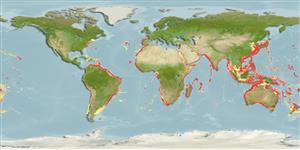
Worldwide in subtropical and tropical oceans. Eastern Atlantic: France to Namibia, including Azores and Madeira. Western Atlantic: southern New England, USA and Gulf of Mexico to [Brazil according to Ref. 7251] Uruguay (Ref. 47377). Pacific Ocean: Hawaii (Ref. 7490), Japan (Ref. 559) and Nazca and Sala-y-Gomez (Ref. 50546).
Größe / Gewicht / Alter
Geschlechtsreife: Lm ? range ? - ? cm
Max length : 30.5 cm TL Männchen/unbestimmt; (Ref. 26340); common length : 15.0 cm TL Männchen/unbestimmt; (Ref. 27000); max. veröff. Gewicht: 170.00 g (Ref. 5217)
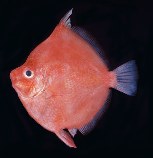
Rückenflossenstacheln (insgesamt) : 8 - 9; Rückenflossenweichstrahlen (insgesamt) : 33 - 37; Afterflossenstacheln: 3; Afterflossenweichstrahlen: 30 - 35. Body orange red, 3 dark red bands on eye, mid-body and caudal peduncle (Ref. 13608). Mouth oblique; longest dorsal spine about 1/4 of SL (Ref. 559).
Body shape (shape guide): short and / or deep; Cross section: compressed.
Adults are found close to bottom while juveniles occur in mid water (Ref. 4952). Feed on small mollusks and crustaceans (Ref. 5288). Not regularly marketed (Ref. 5217).
Lebenszyklus und Paarungsverhalten
Geschlechtsreife | Fortpflanzung | Ablaichen | Eier | Fruchtbarkeit | Larven
Karrer, C. and A. Post, 1990. Caproidae. p. 641-642. In J.C. Quero, J.C. Hureau, C. Karrer, A. Post and L. Saldanha (eds.) Check-list of the fishes of the eastern tropical Atlantic (CLOFETA). JNICT, Lisbon; SEI, Paris; and UNESCO, Paris. Vol. 2. (Ref. 4504)
IUCN Rote Liste Status (Ref. 130435: Version 2025-2 (Global))
Bedrohung für Menschen
Harmless
Nutzung durch Menschen
Fischereien: weniger kommerziell
Tools
Zusatzinformationen
Download XML
Internet Quellen
Schätzungen auf der Grundlage von Modellen
Bevorzugte Temperatur (Ref.
123201): 10.5 - 23.6, mean 15.9 °C (based on 997 cells).
Phylogenetischer Diversitätsindex (Ref.
82804): PD
50 = 0.5000 [Uniqueness, from 0.5 = low to 2.0 = high].
Bayesian length-weight: a=0.02570 (0.01901 - 0.03475), b=2.99 (2.90 - 3.08), in cm total length, based on LWR estimates for this species (Ref.
93245).
Trophische Ebene (Ref.
69278): 4.1 ±0.0 se; based on diet studies.
Widerstandsfähigkeit (Ref.
120179): mittel, Verdopplung der Population dauert 1,4 - 4,4 Jahre. (Assuming tm=2-4).
Anfälligkeit der Fischerei (Ref.
59153): Low vulnerability (21 of 100).
🛈
Nährstoffe (Ref.
124155): Calcium = 97.8 [49.0, 215.6] mg/100g; Iron = 0.856 [0.474, 1.596] mg/100g; Protein = 17.7 [16.5, 18.9] %; Omega3 = 0.241 [0.128, 0.461] g/100g; Selenium = 79.8 [35.9, 189.1] μg/100g; VitaminA = 24.1 [6.4, 103.4] μg/100g; Zinc = 0.987 [0.649, 1.481] mg/100g (wet weight);