>
Lampriformes (Velifers, tube-eyes and ribbonfishes) >
Regalecidae (Oarfishes)
Etymology: Regalecus: Latin, regalis = belonging to a king (Ref. 45335).
Περιβάλλον: περιβάλλον / κλιματική ζώνη / εύρος βάθους / εύρος διανομής
Οικολογία
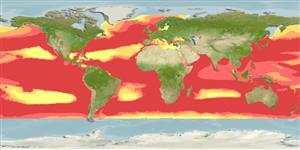
Θαλασσινό(ά) pelagic-oceanic; ωκεανόδρομο(ς) (Ref. 51243); εύρος βάθους 20 - 1000 m (Ref. 9337), usually 20 - 200 m (Ref. 4171). Subtropical; 72°N - 52°S, 180°W - 180°E
Atlantic Ocean: widely distributed, including the Mediterranean (Ref. 231). Indo-Pacific. Eastern Pacific: Topanga Beach in southern California, USA to Chile (Ref. 2850).
Μέγεθος / Βάρος / Ηλικία
Γεννητική Ωρίμανση: Lm ? range ? - ? cm
Max length : 800 cm TL αρσενικό/απροσδιόριστο; (Ref. 92949); common length : 300 cm TL αρσενικό/απροσδιόριστο; (Ref. 9337); μεγ. δημοσιευμένο βάρος: 272.0 kg (Ref. 6472)
Σύντομη περιγραφή
Κλείδες προσδιορισμού | Μορφολογία | Μορφομετρία
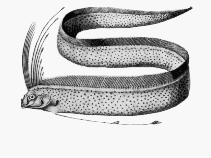
Ραχιαίες άκανθες (συνολικά) : 0; Μαλακές ραχιαίες ακτίνες (συνολικά) : 414 - 449. Head and body silver in color with blue streaks; body with blackish streaks and spots. Dorsal fins crimson in color and with 10-12 + about 400 soft rays. Pelvic fin represented by a prolonged, ribbon-like ray (Ref. 4171). Distinguished by the following features: dorsal fin rays until the end of the abdomen numbering 90 to 120; abdominal vertebrae count 45 to 56; in complete specimens: total vertebrae, 127 to 163 and total dorsal fin rays, 414 to 449; total gill rakers on first gill arch in large fish 33 to 47; dorsal fin in adults with 2 crests: first dorsal fin crest with 6 to 8 rays membranously joined and second dorsal fin crest with 5 to 11 elongated and ornamented rays with no fin membranes connecting them or other dorsal fin rays. Other characteristics: cristophore (new term) present and supports the first dorsal fin crest; pelvic fin with a single permanent, extremely elongate and ornamented ray; 11-14 pectoral-fin rays, with a horizontally-oriented base, allowing the fin to be vertically-oriented when adpressed against the body; all large fish lacking a caudal fin, but in the young, principal rays number 3-4 (usually 4), may be extremely elongate, and the tip rarely with ornament; lacking procurrent rays; highly elongate body, with no anal fin; total dorsal fin rays in complete specimens (significantly less in individuals of approx. max. TL of 1.5 m), 3 33 to 449 and total vertebrae 113 to 163; approx. max. length of largest specimens, 8 m (all autotomized); stomach characterized with an elongate postabdominal caecum extending to end of body; muscle masses compartmentalized by a complex system of connected intermuscular septa; with up to three dorsal horizontal septa and three ventral horizontal septa in addition to the horizontal, vertical, and transverse septa common to most teleosts; as a result of autotomy, the posterior part of the adult body (including most large juveniles) terminating in a healed-over stump or terminus (new term); still, many specimens found with fresh (with a ragged appearance very different from a healed termini) incomplete self-amputations of the posterior part of the body, notably not consistent with shark bites. Toothless jaws or with only some tine vestigial teeth (Ref. 92949).
Body shape (shape guide): eel-like.
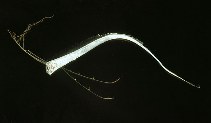
Cool-water, anti-tropical distribution, at latitudes greater than 15° (Ref. 92949). Oceanic and can live at great depths (Ref. 2850), but occasionally cast up on beaches (Ref. 9563). Large adults sometimes kill themselves by swimming out of the water onto beaches; occurrence of such strandings may be linked to certain areas, seasons or months and often in spates. With a unique adaptation of self-amputation (autotomy) of the posterior part of the body past the vent which may involve only the caudal fin (or one to a few small adjacent vertebrae) or as far anterior as just before the abdomen; apparently occurs several times during its lifetime (serial autotomy) but do not damage any vital organs and are usually survived except in strandings. All records over 1.5 m long have bodies shortened by autotomy and may exhibit a healed-over stump or "terminus"; still, many specimens found with fresh (with a ragged appearance very different from a healed termini) incomplete self-amputations of the posterior part of the body, notably not consistent with shark bites; the lost part is never regenerated. Species of this Regalecus attain lengths of 7-8 meters and this is well established by documented specimens. Oftentimes vertically suspended head-up in clear oceanic or inshore waters with the rays of the two dorsal fin crests usually extended vertically upwards while the pelvic fin rays may be horizontally spread outward and away from the body (Ref. 92949). This is hypothesized to be a feeding stance that visually allows the fish to spot the silhouette of its potential prey against the skylight (Ref. 49905). Feed on euphausiid crustaceans, small fishes and squid (Ref. 6738). Toothless protrusile jaws work to suction krill-laden water into its oro-branchial cavity and retained in the gullet by the long, spiny and bristly gill rakers (Ref. 92949). Occassionally associate in pairs (gender undocumented) but no record of group larger than three or of schooling behavior (Ref. 92949). Spawning occurs between July and December and larvae are encountered near the surface (Ref. 9337). Mature individuals spawn in the North Atlantic along the west coast of Florida and off the northern coast of America; in or near the Straits of Messina in the Mediterranean; in the South Pacific in the Catham Rise area of New Zealand and somewhere off the west coast of southern Australia (Ref. 92949). In Guinness Book of Records as longest bony fish (Ref. 6472). Also caught with encircling nets and marketed fresh (Ref. 9337). Reputed to be unpalatable because the flesh is tasteless or otherwise unappetizing (Ref. 92949). Underwater footage shows them slowly swimming vertically, head up, with a stiff body, only undulating the dorsal fin, and with photophores on their appendages. The mouth can be protruded for capturing prey (RF, pers. comm. 2013).
Are broadcast spawners with no parental care for the young (Ref. 92949).
Bauchot, M.-L., 1987. Poissons osseux. p. 891-1421. In W. Fischer, M.L. Bauchot and M. Schneider (eds.) Fiches FAO d'identification pour les besoins de la pêche. (rev. 1). Méditerranée et mer Noire. Zone de pêche 37. Vol. II. Commission des Communautés Européennes and FAO, Rome. (Ref. 3397)
Κατάσταση Κόκκινου Καταλόγου IUCN (Ref. 130435: Version 2025-2 (Global))
Απειλή για τον άνθρωπο
Harmless
Ανθρώπινες χρήσεις
αλιεία: περιορισμένης εμπορικότητας; αλιεία αναψυχής: ναί
Εργαλεία
Ειδικές εκθέσεις
Λήψη XML
Διαδικτυακές πηγές
Εκτιμήσεις βάσει μοντέλων
Προτιμώμενη θερμοκρασία (Αναφ.
123201): 11.2 - 28.9, mean 23.9 °C (based on 7848 cells).
Δείκτης φυλογενετικής ποικιλότητας (Αναφ.
82804): PD
50 = 0.8750 [Uniqueness, from 0.5 = low to 2.0 = high].
Bayesian length-weight: a=0.00102 (0.00046 - 0.00225), b=3.06 (2.88 - 3.24), in cm total length, based on all LWR estimates for this body shape (Ref.
93245).
Τροφικό Επίπεδο (Αναφ.
69278): 3.2 ±0.40 se; based on food items.
Ελαστικότητα (Αναφ.
120179): Πολύ χαμηλό, ελάχιστος χρόνος για διπλασιασμό πληθυσμού > 14 έτη (Assuming tm>10; Fec = 139,000).
Ευπάθεια στην αλιεία (Ref.
59153): Very high vulnerability (90 of 100).
🛈
Ευπάθεια στο κλίμα (Ref.
125649): Moderate vulnerability (37 of 100).
🛈
Θρεπτικά συστατικά (Ref.
124155): Calcium = 15.8 [7.1, 29.1] mg/100g; Iron = 0.842 [0.438, 1.613] mg/100g; Protein = 19.5 [16.8, 23.3] %; Omega3 = 0.21 [0.09, 0.45] g/100g; Selenium = 92.6 [41.4, 220.3] μg/100g; VitaminA = 2.99 [0.75, 12.76] μg/100g; Zinc = 0.381 [0.244, 0.602] mg/100g (wet weight);