Klassifizierung / Names
Namen | Synonyme | Catalog of Fishes(Gattung, Arten) | ITIS | CoL | WoRMS | Cloffa
Umwelt: Milieu / Klimazone / Tiefenbereich / Verbreitungsgebiet
Ökologie
; süßwasser demersal; pH range: 7.0 - ? ; dH range: ? - 15; potamodrom (Ref. 126106); tiefenbereich 0 - 55 m (Ref. 1998). Temperate; 4°C - 18°C (Ref. 2059); 69°N - 34°N
North America: Nova Scotia to Northwest Territories and eastern British Columbia in Canada; Great Lakes-Mississippi River basins south to southern Ohio and Nebraska in USA and west to Montana, USA. Isolated population in Canadian River system in northeastern New Mexico, USA. Introduced elsewhere (Ref. 5723). Introduced in upper Inn drainage in Bavaria, Germany and accidentally in the 1960’s with Micropterus to southern Finland where it has established a population in Lake Lohjanjarvi (Ref. 59043).
Größe / Gewicht / Alter
Geschlechtsreife: Lm ? range ? - ? cm
Max length : 8.7 cm TL Männchen/unbestimmt; (Ref. 5723); common length : 5.0 cm TL Männchen/unbestimmt; (Ref. 12193); max. veröff. Alter: 2.00 Jahre (Ref. 12193)
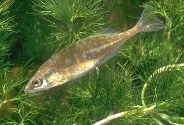
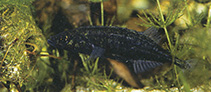
Diagnosed from other species of Gasterosteidae in Europe by combination of the following characters: 4-6 short dorsal spines, never inclined to the left or to the right; without keel on side of caudal peduncle; anal fin origin slightly behind dorsal fin origin; body dark olive green (getting blackish in breeding males), with numerous pale spots or undulating bars on flank (Ref. 59043).
Body shape (shape guide): fusiform / normal.
Adults inhabit cool, vegetated, sand or mud bottoms of lakes and ponds. Also in pools and backwaters of creeks and small rivers (Ref. 1998, 10294). Rarely found in brackish water. They feed on crustacean and insect larvae, eggs and larvae of fishes, snails, oligochaetes and algae (Ref. 1998, 10294). Preyed upon by kingfishers, herons, and mergansers and occasionally by fishes like Salvelinus fontinalis and Esox lucius (Ref. 1998). Males build, guard and aerate the nest where the eggs are deposited (Ref. 205).
Males arrive first in shallow waters, establish their territories, and build small nests near the bottom. The male then entices the female to the nest and by prodding her ventral and caudal peduncle area, forces her to release her eggs into the nest. The male then drives the female away, fertilizes the eggs and guards his territory until the young hatch and swim away. Males may build two nests during a breeding season and more than one female may deposit eggs in each nest (Ref. 1998). Eggs hatch in 8-9 days (Ref. 59043).
Page, L.M. and B.M. Burr, 1991. A field guide to freshwater fishes of North America north of Mexico. Houghton Mifflin Company, Boston. 432 p. (Ref. 5723)
IUCN Rote Liste Status (Ref. 130435: Version 2025-2 (Global))
Bedrohung für Menschen
Harmless
Nutzung durch Menschen
Fischereien: kommerziell; Aquarium: Kommerziell; Köder: occasionally
Tools
Zusatzinformationen
Download XML
Internet Quellen
Schätzungen auf der Grundlage von Modellen
Phylogenetischer Diversitätsindex (Ref.
82804): PD
50 = 1.0000 [Uniqueness, from 0.5 = low to 2.0 = high].
Bayesian length-weight: a=0.01023 (0.00400 - 0.02616), b=3.06 (2.84 - 3.28), in cm total length, based on LWR estimates for this (Sub)family-body shape (Ref.
93245).
Trophische Ebene (Ref.
69278): 3.2 ±0.1 se; based on diet studies.
Widerstandsfähigkeit (Ref.
120179): hoch, Verdopplung der Population dauert weniger als 15 Monate. (tmax=2).
Anfälligkeit der Fischerei (Ref.
59153): Low vulnerability (10 of 100).
🛈