>
Syngnathiformes (Pipefishes and seahorses) >
Syngnathidae (Pipefishes and seahorses) > Syngnathinae
Etymology: Cosmocampus: Greek, kosmos = order, organization + Greek, kampe = bent, curvature (Ref. 45335).
Entorno: milieu / zona climática / rango de profundidad / gama de distribución
Ecología
marino batidemersal; no migratorio (Ref. 52884); rango de profundidad 180 - 270 m. Deep-water
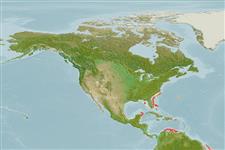
Western Atlantic: known only from eastern Florida in USA and western Caribbean.
Tamaño / Peso / Edad
Madurez: Lm ? range ? - ? cm
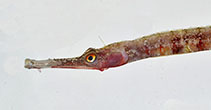
Max length : 20.0 cm TL macho / no sexado; (Ref. 7251)
Descripción breve
Claves de identificación | Morfología | Morfometría
Adults inhabit rubble bottom. Ovoviviparous (Ref. 205). The male carries the eggs in a brood pouch which is found under the tail (Ref. 205).
Ciclo vital y comportamiento de apareamiento
Madurez | Reproducción | Puesta | Huevos | Fecundidad | Larva
Male carries the eggs in a brood pouch (Ref. 205).
Robins, C.R. and G.C. Ray, 1986. A field guide to Atlantic coast fishes of North America. Houghton Mifflin Company, Boston, U.S.A. 354 p. (Ref. 7251)
Situación en la Lista Roja de la UICN (Ref. 130435: Version 2025-2 (Global))
Amenaza para el ser humano
Harmless
Usos humanos
Herramientas
Informes especiales
Descargar XML
Fuentes de Internet
Estimaciones basadas en modelos
Temperatura preferida (Referencia
123201): 15.9 - 22.7, mean 19 °C (based on 17 cells).
Índice de diversidad filogenética (Referencia
82804): PD
50 = 0.5000 [Uniqueness, from 0.5 = low to 2.0 = high].
Bayesian length-weight: a=0.00035 (0.00015 - 0.00079), b=3.19 (3.00 - 3.38), in cm total length, based on LWR estimates for this (Sub)family-body shape (Ref.
93245).
Nivel trófico (Referencia
69278): 3.4 ±0.5 se; based on size and trophs of closest relatives
Resiliencia (Referencia
120179): Medio, población duplicada en un tiempo mínimo de 1.4-4.4 años (Assuming tmax>3).
Vulnerabilidad pesquera (Ref.
59153): Low vulnerability (10 of 100).
🛈