>
Syngnathiformes (Pipefishes and seahorses) >
Syngnathidae (Pipefishes and seahorses) > Syngnathinae
Etymology: Hippocampus: Greek, ippos = horse + Greek,kampe = curvature (Ref. 45335).
Environnement : milieu / zone climatique / profondeur / gamme de distribution
Écologie
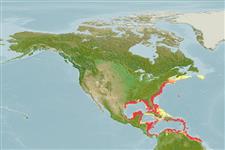
marin récifal; non migrateur; profondeur 0 - 100 m (Ref. 128812). Subtropical; 10°C - 27°C (Ref. 36630); 50°N - 32°S, 98°W - 32°W (Ref. 52034)
Western Atlantic: Canada (off Scotian shelf) to Brazil; including countries of the Gulf of Mexico and the West Indies. A southern form that may prove to be a separate species is known from Rio de Janeiro, Brazil and questionably from Suriname.
Longueur à la première maturité / Taille / Poids / Âge
Maturité: Lm 6.3 range ? - ? cm
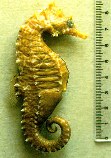
Max length : 17.8 cm SL mâle / non sexé; (Ref. 137577); âge max. reporté: 1.00 années (Ref. 1285)
Épines dorsales (Total) : 0; Rayons mous dorsaux (Total) : 16 - 20.
Body shape (shape guide): other.
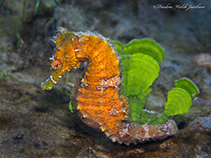
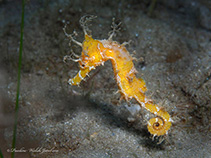
Generally in coastal waters; often around man-made structures (Ref. 26938). Usually attached to gorgonians or seagrasses but may occur in floating Sargassum or swimming freely in midwater (Ref. 9710). Those that live in Sargassum usually have bony protuberances and fleshy tabs that may serve as camouflage. Has been reared in captivity (Ref. 35420, 35422). Move into deeper waters during winter (Ref. 36630). Feeds by sucking in small organisms, using its long face as a pipette (Ref. 26938); like small crustaceans (Ref. 27549). Ovoviviparous (Ref. 205). The male carries the eggs in a brood pouch which is found under the tail (Ref. 205). Length type refers to Height (= from top of coronet to the tip of straightened tail).
Incubates eggs in an external marsupium. Gestation period 20-21 days but varies with water temperature (Ref. 30915).
Lourie, S.A., R.A. Pollom and S.J. Foster, 2016. A global revision of the seahorses Hippocampus Rafinesque 1810 (Actinopterygii: Syngnathiformes): taxonomy and biogeography with recommendations for further research. Zootaxa 4146(1):1-66. (Ref. 115213)
Statut dans la liste rouge de l'IUCN (Ref. 130435: Version 2025-2 (Global))
Menace pour l'homme
Harmless
Utilisations par l'homme
Pêcheries: intérêt commercial mineur; Aquarium: Commercial
Outils
Articles particuliers
Télécharger en XML
Sources Internet
Estimations basées sur des modèles
Température préférée (Réf.
123201): 12.1 - 27, mean 24 °C (based on 144 cells).
Indice de diversité phylogénétique (Réf.
82804): PD
50 = 0.5000 [Uniqueness, from 0.5 = low to 2.0 = high].
Bayesian length-weight: a=0.00447 (0.00176 - 0.01132), b=3.00 (2.78 - 3.22), in cm total length, based on LWR estimates for this (Sub)family-body shape (Ref.
93245).
Niveau trophique (Réf.
69278): 3.5 ±0.51 se; based on food items.
Generation time: 3.2 ( na - na) years. Estimated as median ln(3)/K based on 1
growth studies.
Résilience (Réf.
120179): Haut, temps minimum de doublement de population inférieur à 15 mois (K=0.34; tmax=1; Fec=1,552).
Vulnérabilité de la pêche (Ref.
59153): Low to moderate vulnerability (31 of 100).
🛈
Nutriments (Ref.
124155): Calcium = 47.1 [22.2, 120.5] mg/100g; Iron = 0.62 [0.33, 1.15] mg/100g; Protein = 18.5 [17.4, 19.7] %; Omega3 = 0.186 [0.102, 0.333] g/100g; Selenium = 15.1 [6.8, 35.8] μg/100g; VitaminA = 78.1 [23.5, 255.2] μg/100g; Zinc = 0.985 [0.614, 1.530] mg/100g (wet weight);