>
Gadiformes (Cods) >
Macrouridae (Grenadiers or rattails)
Etymology: Coryphaenoides: Greek, koryphaina = dolphin fish + Suffix oides = similar to (Ref. 45335).
Umwelt: Milieu / Klimazone / Tiefenbereich / Verbreitungsgebiet
Ökologie
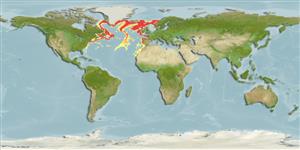
seewasser bathypelagisch; tiefenbereich 180 - 2600 m (Ref. 58426), usually 400 - 1200 m (Ref. 1371). Deep-water; 73°N - 20°N, 77°W - 32°E
North Atlantic: from about 37°N to Baffin Island and Greenland in the western Atlantic, and off Iceland and Norway to 73°N to Barents Sea, south to North Africa in the eastern Atlantic. Reported to occur from the tongue of the Ocean east of Andros Islands (about 24°N, 77°W) in the Bahamas.
Länge bei der ersten Reifung / Größe / Gewicht / Alter
Geschlechtsreife: Lm 52.7, range 60 - ? cm
Max length : 110 cm TL Männchen/unbestimmt; (Ref. 35388); max. veröff. Gewicht: 1.7 kg (Ref. 40637); max. veröff. Alter: 54 Jahre (Ref. 41452)
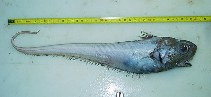
Rückenflossenstacheln (insgesamt) : 2; Afterflossenstacheln: 0. Head broad, rather soft; snout broad, rounded, with a large blunt tubercular scute at its tip; chin with small barbel. Scales relatively adherent; spinules dense on body scales, long, thin and recurved, narrowly lanceolate, with longitudinal anterior concavity. Pyloric caeca 29 to 31, long and slender. Color medium brown to grayish; orbits, oral and branchial cavities, and fins blackish to brownish gray.
Body shape (shape guide): elongated; Cross section: circular.
Benthopelagic to bathypelagic in about 400 and 1200 m depth. Minimum depth from Ref. 1371. Form large schools at 600 to 900 m depth (Ref. 9988). Feed on a variety of fish and invertebrates, but primarily on pelagic crustaceans such as shrimps, amphipods and cumaceans; cephalopods and lantern fishes constitute a lesser portion of the diet. Batch spawner (Ref. 51846). This species is currently facing overexploitation in the North Atlantic. Utilized frozen and for fishmeal; can be fried and baked (Ref. 9988).
Cohen, D.M., T. Inada, T. Iwamoto and N. Scialabba, 1990. FAO species catalogue. Vol. 10. Gadiform fishes of the world (Order Gadiformes). An annotated and illustrated catalogue of cods, hakes, grenadiers and other gadiform fishes known to date. FAO Fish. Synop. 125(10). Rome: FAO. 442 p. (Ref. 1371)
IUCN Rote Liste Status (Ref. 130435: Version 2025-2 (Global))
Bedrohung für Menschen
Harmless
Nutzung durch Menschen
Fischereien: kommerziell
Tools
Zusatzinformationen
Download XML
Internet Quellen
Schätzungen auf der Grundlage von Modellen
Bevorzugte Temperatur (Ref.
123201): 2.7 - 9.4, mean 4.5 °C (based on 270 cells).
Phylogenetischer Diversitätsindex (Ref.
82804): PD
50 = 0.5000 [Uniqueness, from 0.5 = low to 2.0 = high].
Bayesian length-weight: a=0.00219 (0.00111 - 0.00432), b=3.20 (3.03 - 3.37), in cm total length, based on LWR estimates for this (Sub)family-body shape (Ref.
93245).
Trophische Ebene (Ref.
69278): 3.7 ±0.56 se; based on food items.
Widerstandsfähigkeit (Ref.
120179): niedrig, Verdopplung der Population dauert 4,5 - 14 Jahre. (K=0.1; tm=9-11; tmax=54; Fec=10,000).
Prior r = 0.27, 95% CL = 0.18 - 0.40, Based on 4 full stock assessments.
Anfälligkeit der Fischerei (Ref.
59153): High to very high vulnerability (72 of 100).
🛈
Klimaanfälligkeit (Ref.
125649): Moderate vulnerability (38 of 100).
🛈
Nährstoffe (Ref.
124155): Calcium = 17.4 [5.5, 40.4] mg/100g; Iron = 0.296 [0.130, 0.842] mg/100g; Protein = 17.3 [15.4, 19.0] %; Omega3 = 0.104 [0.041, 0.263] g/100g; Selenium = 26.9 [9.0, 74.3] μg/100g; VitaminA = 21.2 [2.7, 168.7] μg/100g; Zinc = 0.429 [0.232, 0.866] mg/100g (wet weight);