Pronotogrammus martinicensis, Roughtongue bass

You can sponsor this page

Pronotogrammus martinicensis (Guichenot, 1868)

Roughtongue bass
Waarneming toevoegen in Fish Watcher
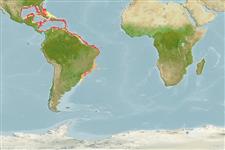
Native range
This map was computer-generated and has not yet been reviewed.
Pronotogrammus martinicensis   AquaMaps   Data sources: GBIF OBIS
Uploaden van uw Foto's en video's
Afbeeldingen | Google afbeelding
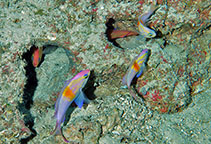
Image of Pronotogrammus martinicensis (Roughtongue bass)
Pronotogrammus martinicensis
Afbeelding van Baldwin, C.C.

Classificatie / Namen Lokale namen | Synoniemen | Catalog of Fishes(Genus, Soort(en)) | ITIS | CoL | WoRMS | Cloffa

> Perciformes/Serranoidei (Groupers) > Anthiadidae (Fairy basslets or Streamer basses)
Etymology: Pronotogrammus: Greek, pro = first, in front of + Greek, noton = back + Greek, gramma = signal, letter (Ref. 45335).
More on author: Guichenot.

Milieu: milieu / Klimaatzone / Diepte / verspreidingsgebied Ecologie

marien demersaal; diepte 65 - 230 m (Ref. 34841). Tropical; 32°N - 36°S

Verspreiding Gebieden | FAO regio's | Ecosystemen | Voorkomen | Verspreidingskaart | Introducties | Faunafri

Western Atlantic: Florida, USA and Bermuda through the Greater Antilles to Rio Grande, Brazil (Ref. 47377).

Grootte / Gewicht / Leeftijd

Maturiteit: Lm ?  range ? - ? cm
Max length : 20.0 cm TL mannelijk / geslacht onbekend; (Ref. 7251); common length : 16.0 cm TL mannelijk / geslacht onbekend; (Ref. 5217); max. gerapporteerde leeftijd: 15 Jaren (Ref. 96848)

Korte beschrijving Determinatiesleutels | Morfologie | Morfometrie

Dorsale stekels (totaal) : 10; Dorsale zachte stralen (totaal) : 13 - 16; Anale stekels: 3; Anale zachte stralen: 7 - 8; Wervels: 26.
Body shape (shape guide): fusiform / normal.

Biologie     Verklarende woordenlijst (bv. epibenthic)

Adults are commonly found on outer continental shelf reefs. They primarily feed on zooplankton while common in the diet of larger predators like snappers and groupers (Ref. 96848).

Levenscyclus en paargedrag Maturiteit | Voortplanting | Paaien | Eieren | Fecunditeit | Larven

Are monandric (males are secondary), protogynous hermaphrodites. About 50% of females transform into males at 7.63 cm SL and 1.0 yr of age (Ref. 96848). During the spawning period, oocytes are found to be in different stages of development indicating asynchronous oocyte development and indeterminate fecundity (Ref. 96848).

Hoofdreferentie Upload uw referenties | Referenties | Coördinator | Medewerkers

Anderson, W.D. Jr. and P.C. Heemstra, 1980. Two new species of Western Atlantic Anthias (Pisces: Serranidae), redescription of A. asperilinguis and review of Holanthias martinicensis. Copeia 1980(1):72-87. (Ref. 34841)

Status op de Rode Lijst van het IUCN (Ref. 130435: Version 2025-2 (Global))

  Niet bedreigd (LC) ; Date assessed: 23 August 2012

CITES

Not Evaluated

CMS (Ref. 116361)

Not Evaluated

Gevaar voor de mens

  Harmless


Gebruik door de mens

Visserij: van geen belang
FAO - Publication: search | FishSource |

Meer informatie

Trofische ecologie
Voedsel (prooien)
Dieetsamenstelling
Voedselconsumptie
Voedselrantsoenen
Predatoren
Ecologie
Ecologie
Populatiedynamica
Groeiparameters
Max. leeftijden / maten
Lengte-gewicht rel.
Lengte-lengte rel.
Lengtefrequenties
Massaconversie
Rekrutering
Abundantie
Levenscyclus
Voortplanting
Maturiteit
Rijpheid/kieuwen rel.
Fecunditeit
Paaien
Paaibestanden
Eieren
Ontwikkeling van de eieren
Larven
Larvale populatiedynamiek
Verspreiding
Gebieden
FAO regio's
Ecosystemen
Voorkomen
Introducties
BRUVS - Video's
Anatomie
Kieuwoppervlak
Hersenen
Otoliet
Fysiologie
Lichaamssamenstelling
Voedingsstoffen
Zuurstofverbruik
Type zwemmen
Zwemsnelheid
Visuele pigmenten
Vis geluid
Ziekten en parasieten
Toxiciteit (LC50)
Genetica
genoom
Genetica
Heterozygositeit
Erfelijkheid
Genetische diversiteit
Menselijk gerelateerd
Aquacultuursystemen
Aquacultuurprofielen
Kweeklijnen
Ciguatera gevallen
Postzegels, munten, diversen.
Outreach
Medewerkers
Referenties
Referenties

Tools

Speciale rapporten

Download XML

Internetbronnen

AFORO (otoliths) | Exoten/Invasieve soorten database | Aquatic Commons | BHL | Cloffa | Websites from users | Bekijk FishWatcher | CISTI | Catalog of Fishes: Genus, Soort(en) | DiscoverLife | ECOTOX | FAO - Publication: search | Faunafri | Fishipedia | Fishtrace | GloBI | GoMexSI (interaction data) | Google Books | Google Scholar | Google | IGFA World Record | OneZoom | Open Tree of Life | Otolith Atlas of Taiwan Fishes | PubMed | Reef Life Survey | Socotra Atlas | TreeBase | Tree of Life | Wikipedia: ga naar, zoek | World Records Freshwater Fishing | Zoological Record

Schattingen op basis van modellen

Gewenste temperatuur (Ref. 123201): 17.3 - 25.8, mean 21.2 °C (based on 86 cells).
Fylogenetische diversiteitsindex (Ref. 82804):  PD50 = 0.6250   [Uniqueness, from 0.5 = low to 2.0 = high].
Bayesian length-weight: a=0.01995 (0.01028 - 0.03874), b=3.00 (2.83 - 3.17), in cm total length, based on LWR estimates for this species & (Sub)family-body (Ref. 93245).
Trofisch niveau (Ref. 69278):  3.5   ±0.5 se; based on size and trophs of closest relatives
Generation time: 5.5 ( na - na) years. Estimated as median ln(3)/K based on 2 growth studies.
Weerstandsvermogen (Ref. 120179):  Gemiddeld, minimale populatieverdubbelingstijd 1,4-4,4 jaar (Preliminary K or Fecundity.).
Kwetsbaarheid van de visserij (Ref. 59153):  Low vulnerability (22 of 100). 🛈