>
Syngnathiformes (Pipefishes and seahorses) >
Centriscidae (Snipefishes and shrimpfishes) > Macroramphosinae
Etymology: Macroramphosus: Greek, makros = great + Greek, rhamphos = beak, bill (Ref. 45335).
More on author: Linnaeus.
Umwelt: Milieu / Klimazone / Tiefenbereich / Verbreitungsgebiet
Ökologie
seewasser demersal; tiefenbereich 25 - 600 m (Ref. 9563), usually 50 - 350 m (Ref. 47377). Subtropical; 66°N - 43°S, 180°W - 180°E
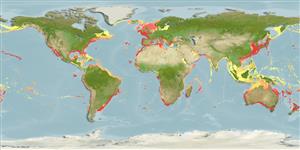
Western Atlantic: Gulf of Maine to Argentina (Ref. 37039). Eastern Atlantic and Mediterranean. Indo-West Pacific. Mainly in temperate latitudes between 20° and 40°N. Presence in Somalia to be confirmed (Ref. 30573).
Größe / Gewicht / Alter
Geschlechtsreife: Lm ? range ? - ? cm
Max length : 20.0 cm TL Männchen/unbestimmt; (Ref. 4508); common length : 12.0 cm TL Männchen/unbestimmt; (Ref. 4508)
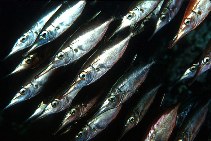
Rückenflossenstacheln (insgesamt) : 6 - 8; Rückenflossenweichstrahlen (insgesamt) : 11 - 13; Afterflossenstacheln: 0; Afterflossenweichstrahlen: 18 - 20; Wirbelzahl: 24. Reddish pink in color, silvery below (Ref. 5382). Body compressed, without scales. Mouth is placed at the end of the long tubular snout (Ref. 35388). Snout length (6.1cm), length of second dorsal spine (LDS 3.9 cm) (Ref. 39875).
Body shape (shape guide): short and / or deep.
Found between the seabed and midwater on the lower continental shelf, over sand. Juveniles found in oceanic surface waters (Ref. 2683); adults normally live close to the bottom (normally in 50-350 m depth (Ref. 47377)). Gregarious. Juveniles feed mainly on pelagic invertebrates, mainly copepods, while adults feed on bottom invertebrates (Ref. 6732). Seems to be sympatric with Macroramphosus gracilis (Lowe, 1839) all around the world (Ref. 89357).
Lebenszyklus und Paarungsverhalten
Geschlechtsreife | Fortpflanzung | Ablaichen | Eier | Fruchtbarkeit | Larven
Ehrich, S., 1990. Macroramphosidae. p. 656-657. In J.C. Quero, J.C. Hureau, C. Karrer, A. Post and L. Saldanha (eds.) Check-list of the fishes of the eastern tropical Atlantic (CLOFETA). JNICT, Lisbon; SEI, Paris; and UNESCO, Paris. Vol. 2. (Ref. 4508)
IUCN Rote Liste Status (Ref. 130435: Version 2025-2 (Global))
Bedrohung für Menschen
Harmless
Nutzung durch Menschen
Fischereien: kommerziell; Aquarium: Öffentliche Aquarien
Tools
Zusatzinformationen
Download XML
Internet Quellen
Schätzungen auf der Grundlage von Modellen
Bevorzugte Temperatur (Ref.
123201): 6.5 - 22.7, mean 13.6 °C (based on 2092 cells).
Phylogenetischer Diversitätsindex (Ref.
82804): PD
50 = 0.7502 [Uniqueness, from 0.5 = low to 2.0 = high].
Bayesian length-weight: a=0.00891 (0.00672 - 0.01183), b=2.83 (2.75 - 2.91), in cm total length, based on LWR estimates for this species (Ref.
93245).
Trophische Ebene (Ref.
69278): 3.5 ±0.40 se; based on food items.
Widerstandsfähigkeit (Ref.
120179): mittel, Verdopplung der Population dauert 1,4 - 4,4 Jahre. (K=0.36-0.46; tmax=6).
Anfälligkeit der Fischerei (Ref.
59153): Low to moderate vulnerability (27 of 100).
🛈
Nährstoffe (Ref.
124155): Calcium = 110 [58, 243] mg/100g; Iron = 1.23 [0.67, 2.37] mg/100g; Protein = 17.8 [16.5, 19.1] %; Omega3 = 0.456 [0.247, 0.880] g/100g; Selenium = 36.1 [17.7, 78.4] μg/100g; VitaminA = 11.3 [3.0, 42.8] μg/100g; Zinc = 0.741 [0.499, 1.099] mg/100g (wet weight);