>
Perciformes/Serranoidei (Groupers) >
Serranidae (Sea basses: groupers and fairy basslets)
Etymology: Paralabrax: Greek, para = the side of + Greek, labrax, -akos = a fish, Dicentrarchus labrax (Ref. 45335).
More on author: Girard.
Milieu: milieu / Klimaatzone / Diepte / verspreidingsgebied
Ecologie
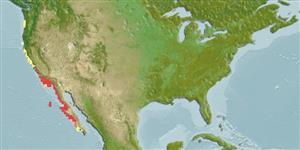
marien benthopelagisch; diepte 1 - 61 m (Ref. 96339), usually 3 - 25 m (Ref. 32351). Subtropical; 48°N - 23°N, 126°W - 109°W
Eastern Pacific: Columbia River in Washington, USA to southern Baja California, Mexico.
Grootte / Gewicht / Leeftijd
Maturiteit: Lm ? range ? - ? cm
Max length : 72.0 cm TL mannelijk / geslacht onbekend; (Ref. 2850); max. gepubliceerd gewicht: 7.0 kg (Ref. 9342); max. gerapporteerde leeftijd: 34 Jaren (Ref. 56049)
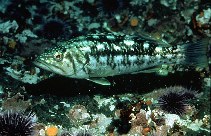
Usually found in or near kelp beds, shallow water and to about 50 m but mostly from 2.4-21m . Found throughout water column. Large specimens usually occur in deeper water. Juveniles feed on benthic invertebrates (especially crustaceans); adults feed on fishes and cephalopods (Ref.9342). Both juveniles and adults may feed on plankton when abundant (Ref.9342). Pelagic spawners (Ref. 56049). Also caught with troll lines (Ref. 9342). Excellent food fish and an important game fish (Ref. 9342).
Pelagic spawner (Ref. 56049). Spawning aggregations are a significant component of the reproductive behavior of this species (Ref. 59326). Also Ref. 103751.
Eschmeyer, W.N., E.S. Herald and H. Hammann, 1983. A field guide to Pacific coast fishes of North America. Boston (MA, USA): Houghton Mifflin Company. xii+336 p. (Ref. 2850)
Status op de Rode Lijst van het IUCN (Ref. 130435: Version 2025-2 (Global))
Gevaar voor de mens
Harmless
Gebruik door de mens
Visserij: commercieel; sportvis: ja
Tools
Speciale rapporten
Download XML
Internetbronnen
Schattingen op basis van modellen
Gewenste temperatuur (Ref.
123201): 12 - 20.1, mean 14.8 °C (based on 12 cells).
Fylogenetische diversiteitsindex (Ref.
82804): PD
50 = 0.5020 [Uniqueness, from 0.5 = low to 2.0 = high].
Bayesian length-weight: a=0.00955 (0.00449 - 0.02029), b=3.05 (2.88 - 3.22), in cm total length, based on LWR estimates for this species & Genus-body shape (Ref.
93245).
Trofisch niveau (Ref.
69278): 3.9 ±0.4 se; based on diet studies.
Generation time: 10.7 ( na - na) years. Estimated as median ln(3)/K based on 1
growth studies.
Weerstandsvermogen (Ref.
120179): laag, minimale populatieverdubbelingstijd 4,5-14 jaar (K=0.10; tm=2.5; tmax=34).
Kwetsbaarheid van de visserij (Ref.
59153): High to very high vulnerability (67 of 100).
🛈
Voedingsstoffen (Ref.
124155): Calcium = 36.5 [15.5, 73.9] mg/100g; Iron = 0.698 [0.381, 1.332] mg/100g; Protein = 17.7 [15.9, 19.4] %; Omega3 = 0.305 [0.171, 0.541] g/100g; Selenium = 28.9 [12.5, 60.3] μg/100g; VitaminA = 34.4 [10.0, 127.5] μg/100g; Zinc = 0.695 [0.494, 1.018] mg/100g (wet weight);