>
Centrarchiformes (Basses) >
Centrarchidae (Sunfishes)
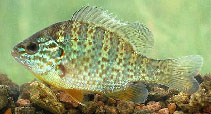
Etymology: Lepomis: Greek, lepis = scaled + Greek, poma = gill cover, operculum (Ref. 45335, 79012); gibbosus: gibbosus from gibbous, or like a full moon, referring to body shape (Ref. 1998).
More on author: Linnaeus.
Entorno: milieu / zona climática / rango de profundidad / gama de distribución
Ecología
; agua dulce; salobre bentopelágico; pH range: 7.0 - 7.5; dH range: 10 - 15; potamodromo (Ref. 51243); rango de profundidad 0 - 41 m (Ref. 1998). Subtropical; 4°C - 30°C (Ref. 1672); 50°N - 32°N, 125°W - 64°W (Ref. 86798)
North America: New Brunswick in Canada south to Savannah River in Georgia, USA; Great Lakes, Hudson Bay (Red River), and upper Mississippi River basins from Quebec west to southeastern Manitoba and North Dakota, and south to north Kentucky and Missouri, USA. Introduced to Pacific drainages from British Columbia to California. Several countries report adverse ecological impact after introduction.
Longitud en la primera madurez / Tamaño / Peso / Edad
Madurez: Lm ? range ? - ? cm
Max length : 40.0 cm TL macho / no sexado; (Ref. 86798); common length : 9.9 cm TL macho / no sexado; (Ref. 12193); peso máximo publicado: 630.00 g (Ref. 4699); edad máxima reportada: 12 años (Ref. 72493)
Espinas dorsales (total) : 10 - 12; Radios blandos dorsales (total) : 10 - 12; Espinas anales: 3; Radios blandos anales: 8 - 11; Vértebra: 28 - 30.
Body shape (shape guide): short and / or deep.
Inhabits vegetated lakes and ponds, as well as quiet pools of creeks and small rivers (Ref. 86798). Feeds on small fishes and other vertebrates (Ref. 1998), as well as fish eggs (Ref. 2058). Adtults rarely form schools but occur in pairs or loose aggregations of three to four individuals; young individuals aggregate in fairly large schools (Ref. 120693). An introduced species in Europe which avoids swift waters and occurs in estuaries with a salinity up to 18.2 ppt (Ref. 59043). Reported in Europe to prey on a wide variety of invertebrates (Ref. 59043). Considered undesirable catch (Ref. 30578).
Males build the nest on very shallow waters near the shore. The pair then swims in a circular path over the nest and eggs and sperm is released in intervals. The male guards the eggs for about 7 days (Ref. 93240) and the young (to about 11 days after hatching), then prepares the nest for another spawning with the same or different females (Ref. 1998). In European waters, each male may spawn with several females in one nest and guard the nest until abandoned by larvae (Ref. 59043). Produces up to 1000 eggs (Ref. 1672). Also Ref. 101194.
Page, L.M. and B.M. Burr, 2011. A field guide to freshwater fishes of North America north of Mexico. Boston : Houghton Mifflin Harcourt, 663p. (Ref. 86798)
Situación en la Lista Roja de la UICN (Ref. 130435: Version 2025-2 (Global))
Amenaza para el ser humano
Potential pest
Usos humanos
Pesquerías: pesquerías de subsistencia; pesca deportiva: si; Acuario: Comercial
Herramientas
Informes especiales
Descargar XML
Fuentes de Internet
Estimaciones basadas en modelos
Índice de diversidad filogenética (Referencia
82804): PD
50 = 0.5001 [Uniqueness, from 0.5 = low to 2.0 = high].
Bayesian length-weight: a=0.01148 (0.00920 - 0.01432), b=3.11 (3.06 - 3.16), in cm total length, based on LWR estimates for this species (Ref.
93245).
Nivel trófico (Referencia
69278): 3.3 ±0.1 se; based on diet studies.
Resiliencia (Referencia
120179): Bajo, población duplicada en un tiempo mínimo de 4.5-14 años (K=0.16-0.29; tm=2; tmax=12; Fec=600-5000).
Vulnerabilidad pesquera (Ref.
59153): Moderate to high vulnerability (49 of 100).
🛈