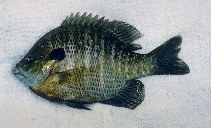
Lepomis macrochirus, Bluegill : fisheries, aquaculture, gamefish, aquarium

You can sponsor this page

Lepomis macrochirus Rafinesque, 1819

Bluegill
muatnaik fotos/gambar dan video
Gambar | video | imej Google
Image of Lepomis macrochirus (Bluegill)
Lepomis macrochirus
Male foto/gambar oleh Lovshin, L.

klasifikasi / Nama Nama-nama umum | Sinonim (persamaan) | Catalog of Fishes(Marga, Jenis) | ITIS | CoL | WoRMS | Cloffa

> Centrarchiformes (Basses) > Centrarchidae (Sunfishes)
Etymology: Lepomis: Greek, lepis = scaled + Greek, poma = gill cover, operculum (Ref. 45335, 79012)macrochirus: macrochirus meaning large hand, probably referring to the body shape (Ref. 10294).
More on author: Rafinesque.

Lingkungan: lingkungan / zona iklim / kisaran kedalaman / jangkauan distribusi Ekologi

; air tawar bentopelagis; pH range: 7.0 - 7.5; dH range: 10 - 15. Subtropical; 1°C - 36°C (Ref. 35682); 50°N - 25°N

Penyebaran Wilayah | Daerah-daerah FAO | Ekosistem | Kemunculan | peta titik | Introduksi | Faunafri

North America: St. Lawrence - Great Lakes and Mississippi river basin; from Quebec to northern Mexico. Widely introduced. Several countries report adverse ecological impact after introduction.

Ukuran / Berat / umur

Kematangan: Lm ?  range ? - ? cm
Max length : 41.0 cm TL jantan/; (Ref. 5723); common length : 19.1 cm TL jantan/; (Ref. 12193); Berat maksimum terpublikasi: 2.2 kg (Ref. 4699); Umur maksimum dilaporkan: 10 Tahun (Ref. 72462)

deskripsi pendek Kunci identifiaksi (pengenalan) | Morfologi | Morfometrik

A dark blue or black "ear" on an extension of the gill cover called the opercular flap; a prominent dark blotch at the base of the dorsal fin, close to the tail; typically olive-green backs, with a blue or purplish sheen along the sides; faint vertical bars may be present along the sides; breeding males may have more blue and orange coloration on their flanks (Ref. 44091).
Body shape (shape guide): short and / or deep.

Biologi     Daftar kata (contoh epibenthic)

Adults are found frequently in lakes, ponds, reservoirs and sluggish streams (Ref. 5723, 10294); occur primarily in reservoirs in Hawaii; preferably live in deep weed beds (Ref. 5723). Active mainly during dusk and dawn. They feed upon snails, small crayfish, insects, worms and small minnows (Ref. 5723). Young feed on crustaceans, insects and worms (Ref. 5723, 10294).

Siklus hidup dan perilaku kawin Kematangan | Reproduksi, perkembang biakan | Pemijahan | telur-telur | Fekunditas | Larva

Males guard the eggs for about 7 days (Ref. 93240). Also Ref. 101194.

rujukan utama Unggah referensi Anda | Acuan | Koordinator | mitra

Page, L.M. and B.M. Burr, 1991. A field guide to freshwater fishes of North America north of Mexico. Houghton Mifflin Company, Boston. 432 p. (Ref. 5723)

Status IUCN Red List (Ref. 130435: Version 2025-2 (Global))

  kurang bimbang (LC) ; Date assessed: 21 August 2018

CITES

Not Evaluated

CMS (Ref. 116361)

Not Evaluated

ancaman kepada manusia

  Potential pest


penggunaan manusia

Perikanan: nilai komersial kecil; Budidaya air: komersial; Ikan buruan: ya; Akuarium: Komersial
FAO - Sistem akuakultur: produksi; ; Publication: search | FishSource |

informasi lanjut

Ekologi trofik
Item makanan (mangsa)
Komposisi makanan
Konsumsi makanan
Ransum makanan
Pemangsa
Ekologi
Ekologi
Dinamika populasi
Parameter pertumbuhan
Maks. usia / ukuran
Panjang-berat rel.
Panjang-panjang rel.
ukuran frekuensi
Konversi massa
pemulihan
Kelimpahan
Siklus hidup
Reproduksi, perkembang biakan
Kematangan
Kedewasaan / insang rel.
Fekunditas
Pemijahan
Agregasi pemijahan
telur-telur
pekembangan telor
Larva
Dinamika larva
Anatomi
Area insang
Otak
Otolith
Fisiologi
Komposisi tubuh
Nutrisi
Konsumsi oksigen
Jenis renang
Kecepatan berenang
Pigmen visual
Suara ikan
Penyakit & Parasit
Toksisitas (LC50)
Genetika
genom
Genetika
Heterozigositas
Diturunkan
Keanekaragaman Genetik
Yang berhubungan dengan manusia
Sistem akuakultur
profil budidaya air
Strain
Kasus Ciguatera
Perangko, koin, dll.
Penjangkauan
mitra
Acuan
Acuan

Alat, peralatan

laporan khas

muat turun XML

Sumber internet

AFORO (otoliths) | Alien/Invasive Species database | Aquatic Commons | BHL | Cloffa | Websites from users | semak peneliti ikan | CISTI | Catalog of Fishes: Marga, Jenis | DiscoverLife | ECOTOX | FAO - Sistem akuakultur: produksi; ; Publication: search | Faunafri | Fishipedia | Fishtrace | GloBI | GoMexSI (interaction data) | Google Books | Google Scholar | Google | IGFA World Record | OneZoom | Open Tree of Life | Otolith Atlas of Taiwan Fishes | Akuarium publik | PubMed | Reef Life Survey | Socotra Atlas | TreeBase | Tree of Life | Wikipedia: pergi, Cari | World Records Freshwater Fishing | Zoobank | Catatan Zoologi

Estimasi berdasarkan model

Indeks keanekaragaman filogenetik (Acuan 82804):  PD50 = 0.5001   [Uniqueness, from 0.5 = low to 2.0 = high].
Bayesian length-weight: a=0.01380 (0.01183 - 0.01610), b=3.13 (3.09 - 3.17), in cm total length, based on LWR estimates for this species (Ref. 93245).
Tingkat Trofik (Acuan 69278):  3.2   ±0.2 se; based on diet studies.
Daya lenting (Acuan 120179):  Rendah, Waktu penggandaan populasi minimum 4.5 - 14 tahun (K=0.19-0.3; tmax=11).
Kerentanan Penangkapan Ikan (Ref. 59153):  Low to moderate vulnerability (33 of 100). 🛈
kategori harga (Ref. 80766):   Unknown.
Nutrisi (Ref. 124155):  Calcium = 53.9 [28.4, 111.3] mg/100g; Iron = 1.02 [0.62, 1.78] mg/100g; Protein = 18.4 [16.4, 20.4] %; Omega3 = 0.397 [0.164, 1.023] g/100g; Selenium = 26 [10, 63] μg/100g; VitaminA = 20.6 [6.4, 59.4] μg/100g; Zinc = 1.06 [0.71, 1.62] mg/100g (wet weight);