>
Centrarchiformes (Basses) >
Centrarchidae (Sunfishes)
Etymology: Micropterus: Greek, mikros = small + Greek,pteron = wing, fin (Ref. 45335); dolomieu: Named after M. Dolomieu, French minerologist and friend of Lacepède (Ref. 1998).
Eponymy: Déodat Gratet de Dolomieu (1750–1801) was a French geologist. [...] (Ref. 128868), visit book page.
More on author: Lacepède.
Окружающая среда: среда / климатическая зона / пределы глубины / диапазон распространения
экология
; пресноводный донно-пелагический; мигрирует в реке (Ref. 126106); пределы глубины 1 - 7 m (Ref. 120820). Subtropical; 9°C - 30°C (Ref. 1998); 50°N - 33°N, 95°W - 63°W (Ref. 86798)
North America: St. Lawrence-Great Lakes system, Hudson Bay (Red River) and Mississippi River basins from southern Quebec in Canada to North Dakota and south to northern Alabama and eastern Oklahoma in the USA. Introduced into many countries for sport fishing. Several countries report adverse ecological impact after introduction.
Длина при первой зрелости / Размер / Вес / Возраст
половая зрелость: Lm 27.0, range 22 - ? cm
Max length : 69.0 cm TL самец/пол неопределен; (Ref. 86798); common length : 8.0 cm TL самец/пол неопределен; (Ref. 3549); наибольший вес (опубликованные данные): 5.4 kg (Ref. 4699); наибольший возраст (опубликованны данные): 26 годы (Ref. 46974)
колючие лучи спинного плавника (общее число) : 9 - 11; членистые (мягкие) лучи спинного плавника (общее число) : 13 - 15; колючие лучи анального плавника: 10 - 11; позвонки: 31 - 32.
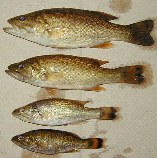
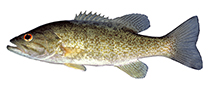
Body shape (shape guide): fusiform / normal.
Adults inhabit shallow rocky areas of lakes and clear and gravel-bottom runs and flowing pools of rivers (Ref. 86798). Young feed on plankton and immature aquatic insects while adults take in crayfish, fishes, and aquatic and terrestrial insects (Refs. 1998, 10294, 44091). They are sometimes cannibalistic (Ref. 30578). Preyed upon by fishes and turtles (Ref. 1998). They build nest, usually at three or four feet deep (Ref. 120821). Excellent food fish (Ref. 1998).
The male builds the nest in shallow waters of lakes and rivers, on sand, gravel, or rocky bottoms. Nest building usually occurs within 150 yards of where his nest was built in previous years. The pair swims about the nest, rubbing and nipping each other and eventually come to rest on the bottom. Actual spawning occurs and lasts for 5 seconds. The pair then encircles the nest for about 25-45 seconds, before settling to spawn again. This goes on for 2 hours. After spawning, the female leaves the nest and may spawn with another male in another nest. Males guard the eggs and young. (Ref. 1998).
Page, L.M. and B.M. Burr, 2011. A field guide to freshwater fishes of North America north of Mexico. Boston : Houghton Mifflin Harcourt, 663p. (Ref. 86798)
Статус Красного Списка МСОП (Ref. 130435: Version 2025-2 (Global))
Угроза для людей
Potential pest
Использование человеком
рыболовство: коммерческий; объект спортивного рыболовства: да; аквариум: общественные аквариумы
дополнительная информация
инструменты
Специальные отчеты
Скачать в формате XML
ресурсы в Интернет
Оценки, основанные на моделях
Индекс филогенетического разнообразия (ссылка
82804): PD
50 = 0.5000 [Uniqueness, from 0.5 = low to 2.0 = high].
Bayesian length-weight: a=0.01096 (0.00902 - 0.01333), b=3.04 (2.98 - 3.10), in cm total length, based on LWR estimates for this species (Ref.
93245).
Трофический уровень (ссылка
69278): 3.6 ±0.2 se; based on diet studies.
Generation time: 6.8 (5.2 - 7.3) years. Estimated as median ln(3)/K based on 26
growth studies.
устойчивость к внешним воздействиям (ссылка
120179): средний (среднего размера), минимальное время удвоения популяции 1.4-4.4 года (K=0.10-0.28; tm=3-6; tmax=14; Fec=5,000).
Уязвимость рыбной ловли (Ref.
59153): Moderate to high vulnerability (49 of 100).
🛈