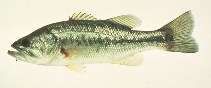
Ambiente: milieu / zona climatica / distribuzione batimetrica / gamma di distribuzione
Ecologia
; acqua dolce benthopelagico; pH range: 7.0 - 7.5; dH range: 10 - ?; distribuzione batimetrica 0 - 6 m (Ref. 1998). Subtropical; 10°C - 32°C (Ref. 12741); 46°N - 24°N, 125°W - 65°W (Ref. 89798)
North America: St. Lawrence - Great Lakes, and Mississippi River basins from southern Quebec to Minnesota and south to Gulf; Atlantic and Gulf drainages from North Carolina to Florida and to northern Mexico. The species has been introduced widely as a game fish and is now cosmopolitan. Several countries report adverse ecological impact after introduction.
Dimensione / Peso / Età
Maturità: Lm ? range ? - ? cm
Max length : 97.0 cm TL maschio/sesso non determinato; (Ref. 86798); common length : 40.0 cm TL maschio/sesso non determinato; (Ref. 556); peso massimo pubblicato: 10.1 kg (Ref. 4699); Età massima riportata: 23 anni (Ref. 46974)
Spine dorsali (totale) : 10; Raggi dorsali molli (totale) : 11 - 14; Spine anali: 3; Raggi anali molli: 10 - 12; Vertebre: 30 - 32.
Body shape (shape guide): fusiform / normal; Cross section: oval.
Inhabit lakes, ponds, swamps, and backwaters and pools of creeks, and small to large rivers (Ref. 86798). Usually found over mud or sand and common in impoundments (Ref. 5723). They prefer quiet, clear water and over-grown banks. Adults feed on fishes, crayfish and frogs; young feed on crustaceans, insects and small fishes. Sometimes cannibalistic. They don't feed during spawning; as well as when the water temperature is below 5°C and above 37°C (Ref. 30578). Builds nest at 25 mm-203 mm deep (Ref. 1998). An introduced species in Europe reported to avoid fast-flowing waters and to occur in estuaries with a salinity up to 13 ppt (Ref. 59043). Popular game fish in North America. Preyed upon by herons, bitterns, and kingfishers (Ref. 1998). Excellent food fish (Ref. 1998).
The male which becomes aggressive and territorial builds the nest on muddy bottoms of shallow water. A female may spawn with several males on different nests. The male guards and fans the eggs for about 29 days (Ref. 93240). Spawning takes place spring to summer or when temperature reaches 15°C. Adults mate between the age of 5-12 years (Ref. 11243). Also Ref, 88808, 101194.
Page, L.M. and B.M. Burr, 2011. A field guide to freshwater fishes of North America north of Mexico. Boston : Houghton Mifflin Harcourt, 663p. (Ref. 86798)
Stato della Lista Rossa IUCN (Ref. 130435: Version 2025-2 (Global))
Minaccia per l'uomo
Potential pest
Usi umani
Pesca: scarso interesse commerciale; Acquacoltura: commerciale; Pesce da pesca sportiva: si; Acquario: Acquari pubblici
Strumenti
Rapporti speciali
Scarica XML
Fonti Internet
Stime basate su modelli
Indice di diversità filogenetica (Fonte Biblio.
82804): PD
50 = 0.5000 [Uniqueness, from 0.5 = low to 2.0 = high].
Bayesian length-weight: a=0.01047 (0.00905 - 0.01212), b=3.08 (3.04 - 3.12), in cm total length, based on LWR estimates for this species (Ref.
93245).
Livello trofico (Fonte Biblio.
69278): 3.8 ±0.4 se; based on diet studies.
Generation time: 5.2 (4.6 - 6.1) years. Estimated as median ln(3)/K based on 41
growth studies.
Resilienza (Fonte Biblio.
120179): Basso, tempo minimo di raddoppiamento della popolazione 4.5 - 14 anni (K=0.06-0.4; tm=1-5; tmax=16; Fec=2,000).
Vulnerabilità della pesca (Ref.
59153): Moderate vulnerability (42 of 100).
🛈
Nutrienti (Ref.
124155): Calcium = 37.3 [15.6, 73.2] mg/100g; Iron = 0.919 [0.527, 1.527] mg/100g; Protein = 19.3 [17.2, 21.3] %; Omega3 = 0.481 [0.197, 1.182] g/100g; Selenium = 28.9 [11.5, 68.9] μg/100g; VitaminA = 19.5 [6.5, 59.1] μg/100g; Zinc = 0.852 [0.603, 1.246] mg/100g (wet weight);