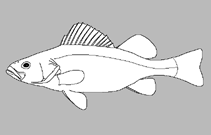
Klassifizierung / Names
Namen | Synonyme | Catalog of Fishes(Gattung, Arten) | ITIS | CoL | WoRMS | Cloffa
>
Perciformes/Percoidei (Perchs) >
Percidae (Perches) > Etheostomatinae
Etymology: Etheostoma: Greek, etheo = to strain + Greek, stoma = mouth; Rafinesque said "various mouths", but Jordan and Evermann suggest the name might have been intended as "Heterostoma (Ref. 45335); barbouri: Named after a well-known vertebrate zoologist, Dr. Roger Barbour (Ref. 10294).
Eponymy: Professor Dr Roger William Barbour (1919–1993) was a vertebrate zoologist who taught and researched at the University of Kentucky. [...] (Ref. 128868), visit book page.
Umwelt: Milieu / Klimazone / Tiefenbereich / Verbreitungsgebiet
Ökologie
; süßwasser benthopelagisch. Temperate; 38°N - 36°N
North America: found only in the middle and upper Green River drainage in Kentucky and Tennessee, USA.
Größe / Gewicht / Alter
Geschlechtsreife: Lm ? range ? - ? cm
Max length : 6.0 cm TL Männchen/unbestimmt; (Ref. 5723); common length : 4.2 cm TL Männchen/unbestimmt; (Ref. 12193); max. veröff. Alter: 2.00 Jahre (Ref. 12193)
Inhabit rocky pools of headwaters, creeks and small rivers (Ref. 5723). Adults feed on midge and blackfly larvae, copepods and cladocerans, and immature mayflies and caddisflies (Ref. 10294).
Lebenszyklus und Paarungsverhalten
Geschlechtsreife | Fortpflanzung | Ablaichen | Eier | Fruchtbarkeit | Larven
Page, L.M. and B.M. Burr, 1991. A field guide to freshwater fishes of North America north of Mexico. Houghton Mifflin Company, Boston. 432 p. (Ref. 5723)
IUCN Rote Liste Status (Ref. 130435: Version 2025-2 (Global))
Bedrohung für Menschen
Harmless
Nutzung durch Menschen
Tools
Zusatzinformationen
Download XML
Internet Quellen
Schätzungen auf der Grundlage von Modellen
Phylogenetischer Diversitätsindex (Ref.
82804): PD
50 = 0.5000 [Uniqueness, from 0.5 = low to 2.0 = high].
Bayesian length-weight: a=0.00676 (0.00303 - 0.01510), b=3.12 (2.94 - 3.30), in cm total length, based on LWR estimates for this Genus-body shape (Ref.
93245).
Trophische Ebene (Ref.
69278): 3.2 ±0.5 se; based on size and trophs of closest relatives
Widerstandsfähigkeit (Ref.
120179): hoch, Verdopplung der Population dauert weniger als 15 Monate. (tmax=2; Fec=17-48).
Anfälligkeit der Fischerei (Ref.
59153): Low vulnerability (10 of 100).
🛈