Milieu: milieu / Klimaatzone / Diepte / verspreidingsgebied
Ecologie
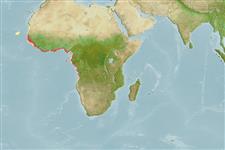
marien; brak water demersaal; diepte 10 - 70 m (Ref. 10799). Tropical; 21°N - 18°S, 27°W - 14°E (Ref. 57343)
Eastern Atlantic: Senegal to Angola (Ref. 57402). Also reported from Mauritania (Ref. 10799) and Cape Verde (Ref. 27000). Reported from Cuba based on a single specimen; no other specimens taken from the western Atlantic (Ref. 57343).
Lengte bij maturiteit / Grootte / Gewicht / Leeftijd
Maturiteit: Lm 15.0 range ? - 17 cm
Max length : 35.0 cm TL mannelijk / geslacht onbekend; (Ref. 57402); common length : 25.0 cm TL mannelijk / geslacht onbekend; (Ref. 3659)
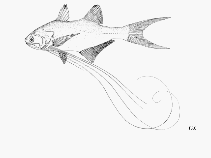
Dorsale stekels (totaal) : 9; Dorsale zachte stralen (totaal) : 14 - 18; Anale stekels: 3; Anale zachte stralen: 28 - 30. Diagnosis: detached pectoral filaments very long, exceeding body length; base of anal fin much longer than base of 2nd dorsal fin; body moderately elongate and compressed, its height comprised 3.0-3.4 in standard length; snout very short, blunt and prominent; mouth inferior; maxillary bone strongly widened at its end, reaching largely past eye; 2 widely separated dorsal fins, 1st with 8 flexible spines, 2nd with 1 spine and 14-18 soft rays; anal fin base much longer than 2nd dorsal fin base; pectoral fin inserted very low on body; threadlike filaments, 5 in number, 4 of them longer than total length of fish; scales ctenoid; head scaly (Ref. 57402).
Coloration: body uniformly silvery, greyish on back, shading to whitish ventrally; fins tinged with yellow (Ref. 57402).
Body shape (shape guide): fusiform / normal.
Adults occur over sandy (Ref. 2683) and muddy bottoms in shallow waters (Ref. 57343), frequently in brackish waters (Ref. 57343, 57402) and estuaries (Ref. 57402). Carnivorous (Ref. 57402), They feed on fish and shrimps (Ref. 28587).
Levenscyclus en paargedrag
Maturiteit | Voortplanting | Paaien | Eieren | Fecunditeit | Larven
Motomura, H., 2004. Threadfins of the world (Family Polynemidae). An annotated and illustrated catalogue of polynemid species known to date. FAO Spec. Cat. Fish. Purp. Rome: FAO. 3:117 p. (Ref. 57343)
Status op de Rode Lijst van het IUCN (Ref. 130435: Version 2025-2 (Global))
Gevaar voor de mens
Harmless
Gebruik door de mens
Visserij: van groot commercieel belang
Tools
Speciale rapporten
Download XML
Internetbronnen
Schattingen op basis van modellen
Gewenste temperatuur (Ref.
123201): 20.2 - 27.9, mean 25.8 °C (based on 70 cells).
Fylogenetische diversiteitsindex (Ref.
82804): PD
50 = 1.0000 [Uniqueness, from 0.5 = low to 2.0 = high].
Bayesian length-weight: a=0.00398 (0.00236 - 0.00672), b=3.13 (2.98 - 3.28), in cm total length, based on LWR estimates for this species & (Sub)family-body (Ref.
93245).
Trofisch niveau (Ref.
69278): 3.6 ±0.57 se; based on food items.
Weerstandsvermogen (Ref.
120179): Hoog, minimale populatieverdubbelingstijd minder dan 15 maanden (K=0.72).
Kwetsbaarheid van de visserij (Ref.
59153): Low to moderate vulnerability (31 of 100).
🛈
Kwetsbaarheid voor het klimaat (Ref.
125649): High to very high vulnerability (75 of 100).
🛈
Voedingsstoffen (Ref.
124155): Calcium = 194 [95, 369] mg/100g; Iron = 1.34 [0.67, 2.39] mg/100g; Protein = 19.5 [18.0, 21.1] %; Omega3 = 0.274 [0.169, 0.428] g/100g; Selenium = 64.3 [33.4, 126.3] μg/100g; VitaminA = 11.4 [5.1, 25.3] μg/100g; Zinc = 1.44 [1.00, 2.11] mg/100g (wet weight);