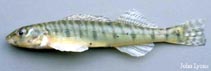
>
Perciformes/Percoidei (Perchs) >
Percidae (Perches) > Etheostomatinae
Etymology: Percina: Latin, diminutive of perch = perch (Ref. 45335); caprodes: caprodes meaning pig-like, referring to the snout shape (Ref. 10294).
More on author: Rafinesque.
Meio ambiente: milieu / Zona climática / intervalo de profundidade / faixa de distribuição
Ecologia
; Água doce bentopelágico. Temperate; 60°N - 30°N
North America: St. Lawrence-Great Lakes, Hudson Bay and Mississippi River basins from Quebec to Saskatchewan in Canada south to Gulf of Mexico; and Atlantic and Gulf Slope drainages in the USA.
Tamanho / Peso / Idade
Maturidade: Lm ? range ? - ? cm
Max length : 18.0 cm TL macho/indeterminado; (Ref. 5723); common length : 12.5 cm TL macho/indeterminado; (Ref. 12193); idade máx. registrada: 3.00 anos (Ref. 12193)
Most common over gravel and sand in medium-sized rivers but can be found almost anywhere from small, fast-flowing rock-bottomed streams to vegetated lakes (Ref. 5723, 10294). Adults feed on larvae of midges, mayflies, caddisflies (especially hydropsychids), riffle beetles, stoneflies, limpets, and fish eggs (Ref. 10294). Eggs are found buried in the substrate (Ref. 7043).
Ciclo de vida ou comportamento de acasalamento
Maturidade | Reprodução | Desova | Ovos | Fecundidade | Larvas
Spawns in running water on sand or fine roots over sand (Ref. 7471). Eggs are found buried in the substrate (Ref. 7043).
Page, L.M. and B.M. Burr, 1991. A field guide to freshwater fishes of North America north of Mexico. Houghton Mifflin Company, Boston. 432 p. (Ref. 5723)
Status na Lista Vermelha da UICN (Ref. 130435: Version 2025-2 (Global))
Ameaça para os humanos
Harmless
Uso pelos humanos
Ferramentas
Relatórios especiais
Baixar XML
Fontes da internet
Estimativas baseadas em modelos
Índice de diversidade filogenética (Ref.
82804): PD
50 = 0.5000 [Uniqueness, from 0.5 = low to 2.0 = high].
Bayesian length-weight: a=0.00631 (0.00359 - 0.01109), b=3.16 (3.00 - 3.32), in cm total length, based on LWR estimates for this species & (Sub)family-body (Ref.
93245).
Nível Trófico (Ref.
69278): 3.4 ±0.46 se; based on food items.
Resiliência (Ref.
120179): médio(a), tempo mínimo de duplicação da população 1,4 - 4,4 anos (tmax=3; Fec=97-611).
Vulnerabilidade da pesca (Ref.
59153): Low vulnerability (10 of 100).
🛈