>
Kurtiformes (Nurseryfishes, cardinalfishes.) >
Apogonidae (Cardinalfishes) > Apogoninae
Etymology: Phaeoptyx: Greek, phaios = dark + Gree, ptyx, -ikos = fold (Ref. 45335).
Eponymy: Dr Edwin Grant Conklin (1863–1952) was an American biologist, zoologist and embryologist. [...] (Ref. 128868), visit book page.
Environnement : milieu / zone climatique / profondeur / gamme de distribution
Écologie
marin récifal; profondeur 0 - 22 m (Ref. 26938). Tropical
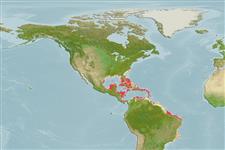
Western Central Atlantic: southern Florida (USA) and Bahamas to northern South America.
Taille / Poids / Âge
Maturité: Lm ? range ? - ? cm
Max length : 9.0 cm SL mâle / non sexé; (Ref. 26938)
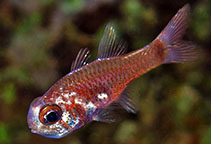
Enlarged melanophores that form large stellate or squarish spots, usually more than 1 per scale below lateral line (Ref. 26938). Vertically elongate blackish blotch at caudal fin base (Ref. 13442).
Body shape (shape guide): fusiform / normal.
Commonly found on shallow rocky and coral bottoms (Ref. 9626), in empty conch shells, rubble, or empty containers. Abundant where Acropora palmata abound (Ref. 9626). Oviparous (Ref. 205). Presence of buccal pouch for brooding eggs (Ref. 39366).
Cycle de vie et comportement reproducteur
Maturité | Reproduction | Frai | Œufs | Fécondité | Larves
Are mouthbrooders (Ref. 240, 58878). Spawning may occur throughout the year (Ref. 39366). Distinct pairing during courtship and spawning (Ref. 205).
Robins, C.R. and G.C. Ray, 1986. A field guide to Atlantic coast fishes of North America. Houghton Mifflin Company, Boston, U.S.A. 354 p. (Ref. 7251)
Statut dans la liste rouge de l'IUCN (Ref. 130435: Version 2025-2 (Global))
Menace pour l'homme
Harmless
Utilisations par l'homme
Outils
Articles particuliers
Télécharger en XML
Sources Internet
Estimations basées sur des modèles
Température préférée (Réf.
123201): 25.4 - 28.2, mean 27.4 °C (based on 719 cells).
Indice de diversité phylogénétique (Réf.
82804): PD
50 = 0.6250 [Uniqueness, from 0.5 = low to 2.0 = high].
Bayesian length-weight: a=0.01122 (0.00521 - 0.02417), b=3.07 (2.89 - 3.25), in cm total length, based on LWR estimates for this (Sub)family-body shape (Ref.
93245).
Niveau trophique (Réf.
69278): 3.5 ±0.5 se; based on size and trophs of closest relatives
Résilience (Réf.
120179): Haut, temps minimum de doublement de population inférieur à 15 mois (Preliminary K or Fecundity.).
Vulnérabilité de la pêche (Ref.
59153): Low vulnerability (10 of 100).
🛈
Nutriments (Ref.
124155): Calcium = 146 [88, 267] mg/100g; Iron = 1.01 [0.61, 1.61] mg/100g; Protein = 19 [18, 20] %; Omega3 = 0.166 [0.101, 0.276] g/100g; Selenium = 25.9 [13.6, 48.0] μg/100g; VitaminA = 106 [38, 298] μg/100g; Zinc = 2.06 [1.40, 2.92] mg/100g (wet weight);