>
Eupercaria/misc (Various families in series Eupercaria) >
Priacanthidae (Bigeyes or catalufas)
Etymology: Priacanthus: Greek, prion = saw + Greek, akantha = thorn (Ref. 45335).
More on author: Cuvier.
Окружающая среда: среда / климатическая зона / пределы глубины / диапазон распространения
экология
морской ассоциированный с рифами; мигрирует в океане (Ref. 51243); пределы глубины 12 - 400 m (Ref. 90102). Subtropical; 32°N - 22°S
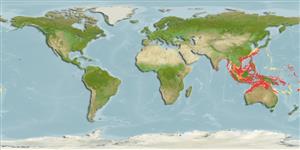
Western Pacific: southern Japan to western Indonesia, the Arafura Sea (Ref. 9819), and Australia. Reported from Peter the Great Bay (Ref. 27683).
Размер / Вес / Возраст
половая зрелость: Lm ? range ? - ? cm
Max length : 30.0 cm SL самец/пол неопределен; (Ref. 48635)
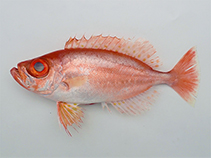
колючие лучи спинного плавника (общее число) : 10; членистые (мягкие) лучи спинного плавника (общее число) : 12 - 14; колючие лучи анального плавника: 3; членистые (мягкие) лучи анального плавника: 13 - 14. Medium-sized fish of moderately deep body. The eyes large; the mouth oblique, with the lower jaw projecting upwards. The body tapers very slightly to beneath the middle of the soft portion of the dorsal fin, and then abruptly to the peduncle. This species is distinguished from P. fitchi by the presence of numerous rusty brown to yellowish spots in the membranes of the dorsal and anal fins, and its less tapered body.
Body shape (shape guide): fusiform / normal; Cross section: compressed.
Occurs in inshore and offshore reefs from less than 20 m to more than 400 m depths. Apparently forms aggregations in open bottom areas and is very abundant in the South China Sea and Andaman Sea. Marketed fresh, whole. Sound production has been studied in this species. Also found under ledges or hovering next to coral heads during day (Ref 90102).
Жизненный цикл и брачное поведение
половая зрелость | размножение | нерест | икра | Плодовитость | личинки
Starnes, W.C., 1988. Revision, phylogeny and biogeographic comments on the circumtropical marine percoid fish family Priacanthidae. Bull. Mar. Sci. 43(2):117-203. (Ref. 5403)
Статус Красного Списка МСОП (Ref. 130435: Version 2025-2 (Global))
Угроза для людей
Harmless
Использование человеком
рыболовство: коммерческий
дополнительная информация
инструменты
Специальные отчеты
Скачать в формате XML
ресурсы в Интернет
Оценки, основанные на моделях
Предпочтительная температура (ссылка
123201): 16.9 - 28, mean 24.4 °C (based on 682 cells).
Индекс филогенетического разнообразия (ссылка
82804): PD
50 = 0.5001 [Uniqueness, from 0.5 = low to 2.0 = high].
Bayesian length-weight: a=0.01622 (0.01239 - 0.02122), b=2.91 (2.84 - 2.98), in cm total length, based on LWR estimates for this species (Ref.
93245).
Трофический уровень (ссылка
69278): 4.1 ±0.60 se; based on food items.
Generation time: 1.5 (1.1 - 2.2) years. Estimated as median ln(3)/K based on 15
growth studies.
устойчивость к внешним воздействиям (ссылка
120179): низкий, минимальное время удвоения популяции 4.5-14 лет (K=0.08-1.3; tmax=6.1).
Prior r = 0.32, 95% CL = 0.21 - 0.48, Based on 1 data-limited stock assessment.
Уязвимость рыбной ловли (Ref.
59153): Low vulnerability (18 of 100).
🛈
Климатическая уязвимость (Ref.
125649): High vulnerability (63 of 100).
🛈
Питательные вещества (Ref.
124155): Calcium = 42.3 [23.6, 84.7] mg/100g; Iron = 0.931 [0.514, 1.629] mg/100g; Protein = 20 [19, 21] %; Omega3 = 0.298 [0.158, 0.546] g/100g; Selenium = 28.8 [13.0, 59.1] μg/100g; VitaminA = 42.2 [14.1, 133.0] μg/100g; Zinc = 0.722 [0.458, 1.100] mg/100g (wet weight); based on
nutrient studies.