Environnement : milieu / zone climatique / profondeur / gamme de distribution
Écologie
marin démersal; profondeur 0 - 270 m (Ref. 58496). Temperate; 4°C - 8°C; 77°N - 43°N, 28°W - 46°E
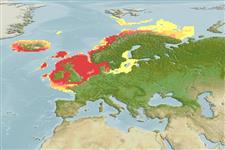
Northeast Atlantic: English Channel to Finmarken and Murman coasts and White Sea, also the Shetlands, the Faroes and southern and southwestern coasts of Iceland; southern part of Baltic.
Taille / Poids / Âge
Maturité: Lm ? range ? - ? cm
Max length : 21.0 cm TL mâle / non sexé; (Ref. 4700); common length : 14.0 cm TL mâle / non sexé; (Ref. 4700); âge max. reporté: 3.00 années (Ref. 722)
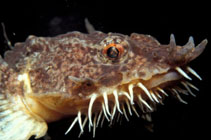
Épines dorsales (Total) : 5 - 6; Rayons mous dorsaux (Total) : 6 - 8; Rayons mous anaux: 5 - 7. Unpaired breast row of plates absent, but paired plate rows cover whole breast. Snout with a pair of strong spiny hooks; numerous barbels on branchiostegal membranes. Dorsal plates 31-34 (Ref. 232). Spiny and soft dorsal fins almost fused. No spines on the hind part of the head (Ref. 35388).
Body shape (shape guide): fusiform / normal.
Inhabits inshore waters, deeper waters in winter in Skaggerak, preferring sandy bottoms, rarely with stones. Maximum depth reported at 270 m (Ref. 28197). Temp. range: 4.0-8.0 °C. Feeds on bottom crustaceans and polychaetes. Matures after about 1 year; a few spawning in the second year (Ref. 722). The eggs are laid in seaweed (Ref. 9900). Spawns in February - April, female laying 2,500-3,000 yellow eggs with a diameter of 2 mm. Period of development is very long and 6-8 mm long pelagic larvae hatch after 10-11 months (Ref. 35388).
Ehrenbaum, E., 1936. Naturgeschichte und wirtschaftliche Bedeutung der Seefische Nordeuropas. Handb. Seefisch. Nordeurop. 2:337 p. (Ref. 40)
Statut dans la liste rouge de l'IUCN (Ref. 130435: Version 2025-2 (Global))
Menace pour l'homme
Harmless
Utilisations par l'homme
Pêcheries: sans intérêt; Aquarium: Aquariums publics
Outils
Articles particuliers
Télécharger en XML
Sources Internet
Estimations basées sur des modèles
Température préférée (Réf.
123201): 7 - 11.7, mean 9.2 °C (based on 442 cells).
Indice de diversité phylogénétique (Réf.
82804): PD
50 = 1.0000 [Uniqueness, from 0.5 = low to 2.0 = high].
Bayesian length-weight: a=0.01023 (0.00395 - 0.02652), b=2.99 (2.77 - 3.21), in cm total length, based on LWR estimates for this (Sub)family-body shape (Ref.
93245).
Niveau trophique (Réf.
69278): 3.4 ±0.3 se; based on diet studies.
Generation time: 2.3 ( na - na) years. Estimated as median ln(3)/K based on 1
growth studies.
Résilience (Réf.
120179): Milieu, temps minimum de doublement de population : 1,4 à 4,4 années (K=0.47; tm=1-4; tmax=3; Fec=2,400).
Vulnérabilité de la pêche (Ref.
59153): Low to moderate vulnerability (26 of 100).
🛈
Nutriments (Ref.
124155): Calcium = 66.7 [36.3, 143.8] mg/100g; Iron = 0.486 [0.257, 0.865] mg/100g; Protein = 17.4 [16.0, 18.8] %; Omega3 = 1.1 [0.5, 3.1] g/100g; Selenium = 14.9 [7.8, 33.6] μg/100g; VitaminA = 18.4 [5.7, 55.2] μg/100g; Zinc = 0.681 [0.485, 0.986] mg/100g (wet weight);