>
Ovalentaria/misc (Various families in series Ovalentaria) >
Embiotocidae (Surfperches)
Etymology: Cymatogaster: Greek, kyma,-atos = wave, swelling, bump + Greek, gaster = stomach (Ref. 45335); aggregata: Cymatogater foetus belly - alluding to the fact that it is a live bearer; aggregata crowded together (Ref. 4930).
Окружающая среда: среда / климатическая зона / пределы глубины / диапазон распространения
экология
морской; солоноватоводный демерсальный; немигрирующий; пределы глубины 1 - 146 m (Ref. 2850). Subtropical; 57°N - 21°N, 137°W - 105°W
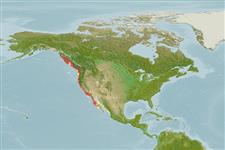
Eastern Pacific: Wrangell, southeastern Alaska to Bahia San Quintin, northern Baja California, Mexico.
Размер / Вес / Возраст
половая зрелость: Lm ? range ? - ? cm
Max length : 20.3 cm TL самец/пол неопределен; (Ref. 27547); common length : 11.5 cm TL самец/пол неопределен; (Ref. 12193); наибольший возраст (опубликованны данные): 9 годы (Ref. 56049)
Краткое описание
определительные ключи | морфология | морфометрия
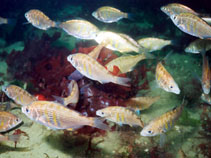
колючие лучи спинного плавника (общее число) : 8 - 11; членистые (мягкие) лучи спинного плавника (общее число) : 19 - 22; колючие лучи анального плавника: 3; членистые (мягкие) лучи анального плавника: 22 - 25; позвонки: 33 - 37. Distinguished by the rather deep, compressed body, the large scales, and the three spines in the anal fin (Ref. 27547). Lateral line slightly arched, complete (Ref. 27547). Generally silvery, with back dusky to greenish; middle of sides toward head are scales with groups of fine black dots on them, forming about eight longitudinal stripes; the stripes are often interrupted, especially in females, by three pale yellow, vertical bands; paired fins colorless; dorsal and caudal fins plain or dusky; anal fin usually colorless, sometimes with a yellow blotch toward the front (Ref. 27547). Breeding males may be almost solid black and develop fleshy lobes on both sides of anal fin (Ref. 27547).
Body shape (shape guide): short and / or deep.
Usually in shallow water, around eelgrass beds, piers and pilings and commonly found in bays and quiet back waters (Ref. 2850). Also in calm areas of exposed coast (Ref. 2850). Enter estuaries and brackish waters (Ref. 114138) [noted from freshwaters in Ref. 2850, but it is unlikely or rarely]. Found in loose schools or aggregations (Ref. 2850, Ref. 114138). Young feed mainly on copepods, while adults eat various small crustaceans, mollusks, and algae (Ref. 27547). Viviparous, female carries the developing young (Ref. 205). Exhibit seasonal onshore-offshore movements (Ref. 27547).
Viviparous. Mating is preceded by courtship. The male moves slowly toward the female, who retreats. Her flight stimulates pursuit by up to 10 males. During the pursuit, males attempt to bring their anal regions in contact with that of the female. One male heads off the female, urging her away from the group of males and also driving them away. The female is conducted to the shelter of a rock or other object, where the courtship dance begins. In this dance, the male, with dorsal fin fully erect, swims by means of his pectoral fin in a figure eight pattern over the female, udulating in both the horizontal and vertical planes. The male then stops, faces the female head to head, quivers, then moves his jaws and undulates his dorsal fin. He then moves beside the female, facing in the same direction, and repeats the movements. Finally, the male tilts on his side, the female tilts slightly away from hin, and the anal regions are brought in contact with each other. Copulation lasts less than a second. Gestation takes five to six months. Bears 3 to 36 young. Female carries the developing young (Ref. 205). Males are mature and ripe at birth. Juvenile females are mated soon after being born (Ref. 27547).
Eschmeyer, W.N., E.S. Herald and H. Hammann, 1983. A field guide to Pacific coast fishes of North America. Boston (MA, USA): Houghton Mifflin Company. xii+336 p. (Ref. 2850)
Статус Красного Списка МСОП (Ref. 130435: Version 2025-2 (Global))
Угроза для людей
Harmless
Использование человеком
рыболовство: не имеет хозяйственного значения; объект спортивного рыболовства: да; наживка: occasionally
дополнительная информация
инструменты
Специальные отчеты
Скачать в формате XML
ресурсы в Интернет
Оценки, основанные на моделях
Предпочтительная температура (ссылка
123201): 8 - 12.1, mean 9.7 °C (based on 100 cells).
Индекс филогенетического разнообразия (ссылка
82804): PD
50 = 1.0000 [Uniqueness, from 0.5 = low to 2.0 = high].
Bayesian length-weight: a=0.01905 (0.00831 - 0.04372), b=2.97 (2.76 - 3.18), in cm total length, based on LWR estimates for this (Sub)family-body shape (Ref.
93245).
Трофический уровень (ссылка
69278): 3.0 ±0.31 se; based on food items.
устойчивость к внешним воздействиям (ссылка
120179): высокий, минимальное время удвоения популяции до 15 месяцев (tm=1; tmax=9; Fec=3-78).
Уязвимость рыбной ловли (Ref.
59153): Low vulnerability (10 of 100).
🛈
Питательные вещества (Ref.
124155): Calcium = 138 [81, 257] mg/100g; Iron = 1.39 [0.71, 2.41] mg/100g; Protein = 18.6 [17.6, 19.7] %; Omega3 = 0.345 [0.203, 0.581] g/100g; Selenium = 29 [15, 58] μg/100g; VitaminA = 7.59 [2.44, 25.34] μg/100g; Zinc = 1.03 [0.72, 1.51] mg/100g (wet weight);