>
Ovalentaria/misc (Various families in series Ovalentaria) >
Pomacentridae (Damselfishes) > Chrominae
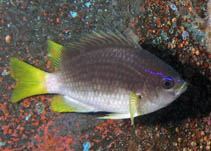
Etymology: Chromis: Greek, chromis = a fish, perhaps a perch (Ref. 45335); enchrysurus: Named as ἔνχρυσος (en('enchrysos), meaning deepep golden, and ορὺά (o'oura'), for tail, named for its
bright yellow caudal fin. Species authors did not specify whether enchrysurus was intended as an adjective or noun in apposition. Thus, following article 31.2 of the International Code of Zoological Nomenclature, if it is unclear how the name was intended, the name should then be treated as a noun in apposition.
More on authors: Jordan & Gilbert.
Umwelt: Milieu / Klimazone / Tiefenbereich / Verbreitungsgebiet
Ökologie
seewasser riff-verbunden; standorttreu; tiefenbereich 5 - 97 m (Ref. 123501), usually 40 - 70 m (Ref. 9710). Tropical; 32°N - , 95°W - 29°W
Western Atlantic: Gulf of Mexico to the eastern tip of the Yucatan Peninsula, western Cuba, Florida, and the U.S. southern Atlantic coast.
Größe / Gewicht / Alter
Geschlechtsreife: Lm ? range ? - ? cm
Max length : 10.0 cm TL Männchen/unbestimmt; (Ref. 9710)
Adults inhabit steep slopes and outer patch reefs. They occur in small groups near small outcrops (Ref. 9710). Oviparous, distinct pairing during breeding (Ref. 205). Eggs are demersal and adhere to the substrate (Ref. 205). Males guard and aerate the eggs (Ref. 205).
Lebenszyklus und Paarungsverhalten
Geschlechtsreife | Fortpflanzung | Ablaichen | Eier | Fruchtbarkeit | Larven
Oviparous, distinct pairing during breeding (Ref. 205). Eggs are demersal and adhere to the substrate (Ref. 205). Males guard and aerate the eggs (Ref. 205).
McFarland, E.P., C.C. Baldwin, D.R. Robertson, L.A. Rocha and L. Tornabene, 2020. A new species of Chromis damselfish from the tropical western Atlantic (Teleostei, Pomacentridae). ZooKeys (1008):107-138. (Ref. 123501)
IUCN Rote Liste Status (Ref. 130435: Version 2025-2 (Global))
Bedrohung für Menschen
Harmless
Nutzung durch Menschen
Tools
Zusatzinformationen
Download XML
Internet Quellen
Schätzungen auf der Grundlage von Modellen
Bevorzugte Temperatur (Ref.
123201): 18.8 - 27.3, mean 23.7 °C (based on 112 cells).
Phylogenetischer Diversitätsindex (Ref.
82804): PD
50 = 0.5000 [Uniqueness, from 0.5 = low to 2.0 = high].
Bayesian length-weight: a=0.01259 (0.00569 - 0.02786), b=3.03 (2.84 - 3.22), in cm total length, based on LWR estimates for this (Sub)family-body shape (Ref.
93245).
Trophische Ebene (Ref.
69278): 3.4 ±0.45 se; based on food items.
Widerstandsfähigkeit (Ref.
120179): hoch, Verdopplung der Population dauert weniger als 15 Monate. (Preliminary K or Fecundity.).
Anfälligkeit der Fischerei (Ref.
59153): Low vulnerability (10 of 100).
🛈
Nährstoffe (Ref.
124155): Calcium = 107 [51, 170] mg/100g; Iron = 0.844 [0.493, 1.444] mg/100g; Protein = 18.2 [16.9, 19.4] %; Omega3 = 0.146 [0.082, 0.255] g/100g; Selenium = 31.1 [15.3, 63.1] μg/100g; VitaminA = 146 [41, 499] μg/100g; Zinc = 1.39 [0.91, 2.01] mg/100g (wet weight);