Entorno: milieu / zona climática / rango de profundidad / gama de distribución
Ecología
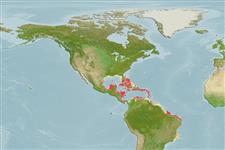
marino asociado a arrecife; no migratorio; rango de profundidad 0 - 10 m (Ref. 27000). Tropical; 33°N - 35°S, 98°W - 31°W
Western Atlantic: including southern Florida (USA), Bermuda, and northern Gulf of Mexico to Brazil.
Tamaño / Peso / Edad
Madurez: Lm ? range ? - ? cm
Max length : 10.0 cm TL macho / no sexado; (Ref. 9710)
Descripción breve
Claves de identificación | Morfología | Morfometría
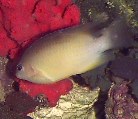
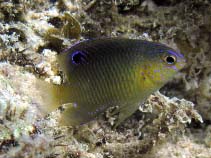
Espinas dorsales (total) : 12; Radios blandos dorsales (total) : 13 - 16; Espinas anales: 2; Radios blandos anales: 12 - 14. Caudal fin slightly forked, with rounded lobes. Dark blue or brown above, yellow below, without obvious narrow vertical lines. Dark spot near back of dorsal fin well above its base becomes smaller in larger fish (Ref. 26938).
Body shape (shape guide): short and / or deep; Cross section: compressed.
Adults occur in seagrass beds, coral or rocky reefs and sandy areas. Also found around mangrove shores and sponge beds; less common on flourishing coral reefs (Ref. 26938). They remain within 50 cm from the substrate. Adults feed on algae, polychaetes, amphipods, foraminiferans and gastropods while juveniles feed on harpacticoid copepods, nemerteans and polychaetes (Ref. 9626). Oviparous, distinct pairing during breeding (Ref. 205). Eggs are demersal and adhere to the substrate (Ref. 205). Males guard and aerate the eggs (Ref. 205). Caught incidentally in traps and small-meshed beach nets (Ref. 5217).
Ciclo vital y comportamiento de apareamiento
Madurez | Reproducción | Puesta | Huevos | Fecundidad | Larva
Oviparous, distinct pairing during breeding (Ref. 205). Males guard and aerate the eggs (Ref. 205). The eggs are deposited inside empty shells or under stones or shell (Ref. 39478).
Allen, G.R., 1991. Damselfishes of the world. Mergus Publishers, Melle, Germany. 271 p. (Ref. 7247)
Situación en la Lista Roja de la UICN (Ref. 130435: Version 2025-2 (Global))
Amenaza para el ser humano
Harmless
Usos humanos
Pesquerías: comercial; Acuario: Comercial
Herramientas
Informes especiales
Descargar XML
Fuentes de Internet
Estimaciones basadas en modelos
Temperatura preferida (Referencia
123201): 26.2 - 28.2, mean 27.5 °C (based on 586 cells).
Índice de diversidad filogenética (Referencia
82804): PD
50 = 0.5000 [Uniqueness, from 0.5 = low to 2.0 = high].
Bayesian length-weight: a=0.01995 (0.01204 - 0.03308), b=2.95 (2.81 - 3.09), in cm total length, based on LWR estimates for this species & Genus-body shape (Ref.
93245).
Nivel trófico (Referencia
69278): 3.1 ±0.2 se; based on diet studies.
Resiliencia (Referencia
120179): Alto, población duplicada en un tiempo mínimo inferior a 15 meses (Preliminary K or Fecundity.).
Vulnerabilidad pesquera (Ref.
59153): Low vulnerability (10 of 100).
🛈
Nutrientes (Ref.
124155): Calcium = 124 [63, 196] mg/100g; Iron = 0.779 [0.462, 1.295] mg/100g; Protein = 18.4 [17.3, 19.5] %; Omega3 = 0.11 [0.06, 0.18] g/100g; Selenium = 18.8 [10.4, 36.2] μg/100g; VitaminA = 95.9 [28.1, 308.4] μg/100g; Zinc = 1.72 [1.15, 2.52] mg/100g (wet weight);