>
Eupercaria/misc (Various families in series Eupercaria) >
Labridae (Wrasses) > Xyrichtyinae
Etymology: Xyrichtys: Greek, xyreo = that cuts like a knife + Greek, ichthys = fish (Ref. 45335).
More on author: Valenciennes.
Environnement : milieu / zone climatique / profondeur / gamme de distribution
Écologie
marin récifal; profondeur 2 - 21 m (Ref. 7251). Subtropical
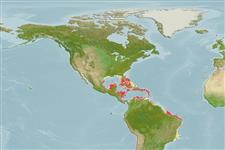
Western Atlantic: southern Florida, USA and Bahamas to northern South America.
Taille / Poids / Âge
Maturité: Lm ? range ? - ? cm
Max length : 19.3 cm SL mâle / non sexé; (Ref. 137577)
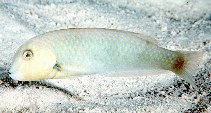
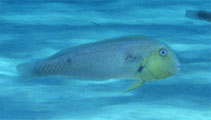
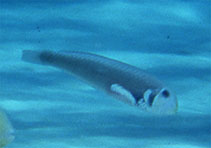
Females light greenish gray, becoming pinkish ventrally, with diffuse orange-red stripe from behind eye to base of caudal fin; a broad white area over abdomen, the lower part with vertical lines of red; there may be faint red bars on the body. Large adult males lose the distinctive red, white and black markings; they develop a vertically elongate blue spot on each body scale; a yellow head with near-vertical pale blue bands, and a large dark spot in axil of pectoral fins (Ref. 13442).
Body shape (shape guide): elongated.
Most common in open sandy areas. Feeds on small sand-dwelling invertebrates. Dives head first into the sand when frightened. Generally common (Ref. 9710). Generally of no interest to fisheries because of its small average size (Ref. 5217).
Cycle de vie et comportement reproducteur
Maturité | Reproduction | Frai | Œufs | Fécondité | Larves
Robins, C.R. and G.C. Ray, 1986. A field guide to Atlantic coast fishes of North America. Houghton Mifflin Company, Boston, U.S.A. 354 p. (Ref. 7251)
Statut dans la liste rouge de l'IUCN (Ref. 130435: Version 2025-2 (Global))
Menace pour l'homme
Harmless
Utilisations par l'homme
Pêcheries: commercial; Aquarium: Commercial
Outils
Articles particuliers
Télécharger en XML
Sources Internet
Estimations basées sur des modèles
Température préférée (Réf.
123201): 25.1 - 28.2, mean 27.4 °C (based on 619 cells).
Indice de diversité phylogénétique (Réf.
82804): PD
50 = 0.5005 [Uniqueness, from 0.5 = low to 2.0 = high].
Bayesian length-weight: a=0.00661 (0.00272 - 0.01607), b=3.05 (2.84 - 3.26), in cm total length, based on LWR estimates for this (Sub)family-body shape (Ref.
93245).
Niveau trophique (Réf.
69278): 3.5 ±0.37 se; based on food items.
Résilience (Réf.
120179): Milieu, temps minimum de doublement de population : 1,4 à 4,4 années (Preliminary K or Fecundity.).
Vulnérabilité de la pêche (Ref.
59153): Low vulnerability (14 of 100).
🛈
Nutriments (Ref.
124155): Calcium = 65.3 [27.2, 142.0] mg/100g; Iron = 0.678 [0.355, 1.489] mg/100g; Protein = 18.7 [15.8, 21.0] %; Omega3 = 0.147 [0.074, 0.285] g/100g; Selenium = 11.4 [4.8, 27.1] μg/100g; VitaminA = 85.4 [22.3, 426.5] μg/100g; Zinc = 1.19 [0.69, 2.13] mg/100g (wet weight);