>
Carangiformes (Jacks) >
Carangidae (Jacks and pompanos) > Caranginae
Etymology: Trachurus: Greek, trachys, -eia, -ys = rough + Greek, oura = tail (Ref. 45335).
Eponymy: Robert Cushman Murphy (1887–1973) was an American naturalist who became Curator of Birds, AMNH, and was a world authority on marine birds. [...] (Ref. 128868), visit book page.
More on author: Nichols.
Entorno: milieu / zona climática / rango de profundidad / gama de distribución
Ecología
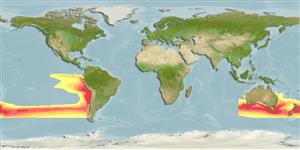
marino pelagic-oceanic; oceanodromo (Ref. 51243); rango de profundidad 10 - 306 m (Ref. 58489), usually 10 - 70 m. Subtropical; 2°N - 51°S, 106°E - 79°W (Ref. 54929)
South Pacific and Southwestern Atlantic: Eastern Central and South Pacific: off Peru and Chile (Ref. 27363), incl. incidental in Juan Fernández Is. (Ref. 89357). Reported from off Ecuador (Ref. 9283). Southwest Pacific: off New Zealand (Ref. 5755). Southwestern Atlantic: off southern Argentina (Ref. 27363)
Longitud en la primera madurez / Tamaño / Peso / Edad
Madurez: Lm 40.5, range 39 - 42 cm
Max length : 70.0 cm TL macho / no sexado; (Ref. 9283); common length : 45.0 cm FL macho / no sexado; (Ref. 9283); edad máxima reportada: 16 años (Ref. 26956)
Descripción breve
Claves de identificación | Morfología | Morfometría
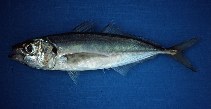
Espinas dorsales (total) : 9; Radios blandos dorsales (total) : 31 - 35; Espinas anales: 3; Radios blandos anales: 27 - 29. Body elongated and little compressed; teeth small and uniseriate; lower branch of first gill arch with 42 to 45 gill rakers; edge of shoulders girdle (cleithrum) with a small furrow at its upper end but lacking papillae; lateral line completely scaled, the scales becoming large scutes posteriorly; scutes in the area of the median curve 1.1 to 1.6 times the diameter of the eye; nape and back metallic blue or dark gray; flanks and belly pale; dorsal edge of operculum with a black stain (Ref. 55763). Body elongate and slightly compressed. Body dark blue dorsally, silvery-white ventrally. Black spot on upper posterior margin of opercle. Fins dusky (Ref. 37339). Pectoral fin falcate and very long (Ref. 27363).
Body shape (shape guide): fusiform / normal.
Adults are found in the shore and open oceanic waters, in schools. They feed mainly on fish larvae and small crustaceans. Marketed fresh (Ref. 9283). Utilized canned for human consumption and also made into fishmeal (Ref. 9988). The species is often found in Juan Fernández Is. as an incidental catch of Pseudocaranx chilensis (Guichenot, 1848) fisheries (Ref. 89357).
Ciclo vital y comportamiento de apareamiento
Madurez | Reproducción | Puesta | Huevos | Fecundidad | Larva
Smith-Vaniz, W.F., 1995. Carangidae. Jureles, pámpanos, cojinúas, zapateros, cocineros, casabes, macarelas, chicharros, jorobados, medregales, pez pilota. p. 940-986. In W. Fischer, F. Krupp, W. Schneider, C. Sommer, K.E. Carpenter and V. Niem (eds.) Guia FAO para Identification de Especies para lo Fines de la Pesca. Pacifico Centro-Oriental. 3 Vols. FAO, Rome. (Ref. 9283)
Situación en la Lista Roja de la UICN (Ref. 130435: Version 2025-2 (Global))
Amenaza para el ser humano
Harmless
Usos humanos
Pesquerías: muy comercial
Herramientas
Informes especiales
Descargar XML
Fuentes de Internet
Estimaciones basadas en modelos
Temperatura preferida (Referencia
123201): 14.1 - 22.6, mean 16.5 °C (based on 352 cells).
Índice de diversidad filogenética (Referencia
82804): PD
50 = 0.5001 [Uniqueness, from 0.5 = low to 2.0 = high].
Bayesian length-weight: a=0.01122 (0.00738 - 0.01705), b=2.92 (2.79 - 3.05), in cm total length, based on LWR estimates for this species & Genus-body shape (Ref.
93245).
Nivel trófico (Referencia
69278): 3.3 ±0.2 se; based on diet studies.
Resiliencia (Referencia
120179): Bajo, población duplicada en un tiempo mínimo de 4.5-14 años (K=0.11; assumed tm>5; tmax=16).
Prior r = 0.52, 95% CL = 0.34 - 0.77, Based on 1 full stock assessment.
Vulnerabilidad pesquera (Ref.
59153): High to very high vulnerability (67 of 100).
🛈
Vulnerabilidad climática (Ref.
125649): Moderate vulnerability (35 of 100).
🛈
Nutrientes (Ref.
124155): Calcium = 183 [110, 285] mg/100g; Iron = 3.54 [2.21, 5.69] mg/100g; Protein = 19.1 [18.4, 19.9] %; Omega3 = 0.282 [0.185, 0.424] g/100g; Selenium = 26.8 [16.4, 42.5] μg/100g; VitaminA = 15.8 [3.8, 77.4] μg/100g; Zinc = 2.08 [1.59, 2.88] mg/100g (wet weight); based on
nutrient studies.