>
Blenniiformes (Blennies) >
Dactyloscopidae (Sand stargazers)
Etymology: Gillellus: Theodore Nicolas Gill (1837-1914) researcher of abyssal fishes and systematics (Ref. 45335).
Окружающая среда: среда / климатическая зона / пределы глубины / диапазон распространения
экология
морской демерсальный. Tropical; - 9°N
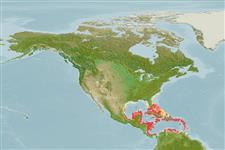
Western Atlantic: southeastern Florida, USA and Bahamas to Panama.
Размер / Вес / Возраст
половая зрелость: Lm ? range ? - ? cm
Max length : 5.0 cm TL самец/пол неопределен; (Ref. 7251)
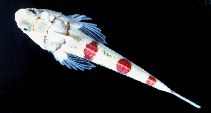
колючие лучи спинного плавника (общее число) : 11 - 15; членистые (мягкие) лучи спинного плавника (общее число) : 14 - 17; колючие лучи анального плавника: 2. Common amongst Dactyloscopidae: Small, elongate fishes. Head usually broad and deep, body tapering and compressed behind. Eyes on top of head, often protrusible; mouth moderate to large, oblique to vertical; jaw teeth minute, in 2 or more series; no teeth on roof of mouth (vomer and palatines). Opercular opening large, gill membrane free from isthmus; opercles membranous, large, usually overlapping on underside of head, typically fringed above with 2 to 24 fleshy fimbriae. Dorsal fin continuous, with an isolated or semi-isolated anterior finlet, or with 1 to 5 separate anterior rays; dorsal-fin spines 7 to 23; anal-fin spines 2; dorsal and anal fins free or united to caudal fin by fragile membranes; pectoral fins broad-based, usually enlarged in mature males; caudal-fin rays simple or branched; pelvic fins under throat (insertion anterior to pectoral-fin base), with 1 spine and 3 thickened segmented rays; all other rays simple. Head and venter naked, body elsewhere with large cycloid scales (smooth to touch); lateral line high anteriorly, deflecting ventrally behind pectoral fin to continue along middle of side to caudal-fin base where terminal lateral-line scale bears ventrally directed canal. Body coloration, variably pale to strongly pigmented with white, brown, or reddish; some forms with characteristic saddle-like bars crossing back; others plain, mottled, or with indications of lateral stripes. Species distinguished by: dorsal-fin origin on nape; with an isolated or semi-isolated anterior finlet. First preopercular canal not branched, with a single distal pore. Segmented caudal-fin rays usually 10. Arched lateral-line scales 22 to 33. Upper lip without fimbriae (Ref.52855).
Body shape (shape guide): elongated.
Occurs in sand around rocks and patch reefs (Ref. 5521). Burrows in soft sandy bottom, where it waits for prey, with only the eyes, nose and mouth protruding.
Жизненный цикл и брачное поведение
половая зрелость | размножение | нерест | икра | Плодовитость | личинки
Dawson, C.E., 1982. Atlantic sand stargazers (Pisces: Dactyloscopidae), with description of one new genus and seven new species. Bull. Mar. Sci. 32(1):14-85. (Ref. 27742)
Статус Красного Списка МСОП (Ref. 130435: Version 2025-2 (Global))
Угроза для людей
Harmless
Использование человеком
дополнительная информация
инструменты
Специальные отчеты
Скачать в формате XML
ресурсы в Интернет
Оценки, основанные на моделях
Предпочтительная температура (ссылка
123201): 26.4 - 28.2, mean 27.4 °C (based on 478 cells).
Индекс филогенетического разнообразия (ссылка
82804): PD
50 = 0.5010 [Uniqueness, from 0.5 = low to 2.0 = high].
Bayesian length-weight: a=0.00389 (0.00180 - 0.00842), b=3.12 (2.94 - 3.30), in cm total length, based on all LWR estimates for this body shape (Ref.
93245).
Трофический уровень (ссылка
69278): 3.9 ±0.6 se; based on size and trophs of closest relatives
Уязвимость рыбной ловли (Ref.
59153): Low vulnerability (10 of 100).
🛈