>
Carangiformes (Jacks) >
Carangidae (Jacks and pompanos) > Caranginae
Etymology: Trachurus: Greek, trachys, -eia, -ys = rough + Greek, oura = tail (Ref. 45335).
More on author: Jenyns.
Ambiente: milieu / zona climatica / distribuzione batimetrica / gamma di distribuzione
Ecologia
marino; salmastro benthopelagico; distribuzione batimetrica 27 - 460 m (Ref. 27930), usually ? - 300 m (Ref. 9072). Temperate; ? - 16°C (Ref. 9072); 9°S - 53°S, 112°E - 177°E (Ref. 54926)
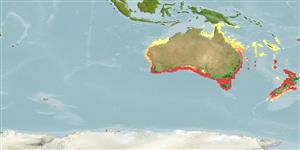
Southwest Pacific: Western Australia to New South Wales, including New Zealand. Principal component analysis of morphometric and meristic characters indicates three separate subpopulations in the Great Australian Bight, off New South Wales, and off Tasmania (Ref. 7456).
Lunghezza alla prima maturità / Dimensione / Peso / Età
Maturità: Lm 31.5, range 23 - 37 cm
Max length : 64.0 cm SL maschio/sesso non determinato; (Ref. 33839); common length : 42.0 cm TL maschio/sesso non determinato; (Ref. 9258); Età massima riportata: 25 anni (Ref. 9072)
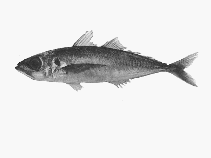
Spine dorsali (totale) : 9; Raggi dorsali molli (totale) : 29 - 35; Spine anali: 3; Raggi anali molli: 24 - 29; Vertebre: 24. Adults are elongate and slightly compressed, and have a primary lateral line with 71-89 scutes, and a secondary lateral line reaching to below dorsal-fin rays 7-9 (Ref. 33616).
Body shape (shape guide): fusiform / normal.
Adults are commonly found near the bottom, in midwater and occasionally at the surface (Ref. 9258) in continental shelf waters (Ref. 27930). They form pelagic schools for most of the year but may move close to the sea bed during winter (Ref. 27931). Generally found at less than 300 m water depth with temperature less than 16° C (Ref. 9072). Juveniles inhabit coastal and estuarine waters although they may sometimes be found offshore (Ref. 27930). Adults feed mostly during the day mainly on krill and other planktonic crustaceans, light fish (Sternoptychidae) and lantern fish (Myctophidae) at the edge of the continental shelf (Ref. 27933).
Eggs and sperm are released amongst schooling fish, possibly deep in the water column near the edge of the continental shelf. Eggs are distributed between the surface and the thermocline and larvae are carried inshore by currents.
Paxton, J.R., D.F. Hoese, G.R. Allen and J.E. Hanley, 1989. Pisces. Petromyzontidae to Carangidae. Zoological Catalogue of Australia, Vol. 7. Australian Government Publishing Service, Canberra, 665 p. (Ref. 7300)
Stato della Lista Rossa IUCN (Ref. 130435: Version 2025-2 (Global))
Minaccia per l'uomo
Harmless
Usi umani
Pesca: elevato interesse commerciale; Pesce da pesca sportiva: si; esca: usually
Strumenti
Rapporti speciali
Scarica XML
Fonti Internet
Stime basate su modelli
Temperatura preferita (Fonte Biblio.
123201): 11.1 - 20.2, mean 14.4 °C (based on 135 cells).
Indice di diversità filogenetica (Fonte Biblio.
82804): PD
50 = 0.5001 [Uniqueness, from 0.5 = low to 2.0 = high].
Bayesian length-weight: a=0.01230 (0.00763 - 0.01985), b=2.97 (2.83 - 3.11), in cm total length, based on LWR estimates for this species & Genus-body shape (Ref.
93245).
Livello trofico (Fonte Biblio.
69278): 3.9 ±0.61 se; based on food items.
Resilienza (Fonte Biblio.
120179): Medio, tempo minimo di raddoppiamento della popolazione 1.4 - 4.4 anni (K=0.23; tm=2-4; tmax=28).
Vulnerabilità della pesca (Ref.
59153): Moderate to high vulnerability (50 of 100).
🛈
Vulnerabilità climatica (Ref.
125649): Moderate vulnerability (36 of 100).
🛈
Nutrienti (Ref.
124155): Calcium = 77.5 [42.0, 170.3] mg/100g; Iron = 0.869 [0.471, 1.819] mg/100g; Protein = 18.5 [17.5, 19.5] %; Omega3 = 0.576 [0.312, 1.073] g/100g; Selenium = 17.1 [7.6, 37.4] μg/100g; VitaminA = 20.1 [4.3, 87.3] μg/100g; Zinc = 1.36 [0.89, 2.08] mg/100g (wet weight);