>
Blenniiformes (Blennies) >
Clinidae (Clinids)
Etymology: metzi: Named after W.P. Gibbons, an early naturalist from Alameda, California and C.W. Metz, perceptive student of the genus Gibbonsia (Ref. 6885, 27436).
Eponymy: Dr William P Gibbons (1812–1897) was a physician and naturalist from Delaware. [...] Dr Charles William Metz (1889–1975) was an American zoologist, geneticist and taxonomist whose doctorate was awarded by Stanford University. He co-wrote: A catalog of the fishes known from the waters of Korea (1913). (Ref. 128868), visit book page.
More on author: Hubbs.
Environnement : milieu / zone climatique / profondeur / gamme de distribution
Écologie
marin démersal; profondeur 0 - 9 m (Ref. 2850). Subtropical; 51°N - 27°N, 129°W - 114°W
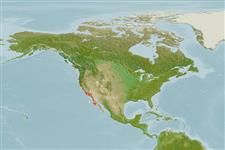
Eastern Pacific: Vancouver Island, British Columbia, Canada to central Baja California, Mexico.
Taille / Poids / Âge
Maturité: Lm ? range ? - ? cm
Max length : 24.0 cm TL mâle / non sexé; (Ref. 2850)
Description synthétique
Clés d'identification | Morphologie | Morphométrie
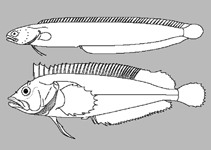
Épines dorsales (Total) : 34 - 37; Rayons mous dorsaux (Total) : 7 - 10; Épines anales: 2; Rayons mous anaux: 24 - 27; Vertèbres: 49. Caudal and pectorals rounded (Ref. 6885). Red or brown, weakly striped or mottled with darker shades (Ref. 6885).
Body shape (shape guide): elongated.
Found among seaweeds, especially in tide pools and kelp.
Cycle de vie et comportement reproducteur
Maturité | Reproduction | Frai | Œufs | Fécondité | Larves
Eschmeyer, W.N., E.S. Herald and H. Hammann, 1983. A field guide to Pacific coast fishes of North America. Boston (MA, USA): Houghton Mifflin Company. xii+336 p. (Ref. 2850)
Statut dans la liste rouge de l'IUCN (Ref. 130435: Version 2025-2 (Global))
Menace pour l'homme
Harmless
Utilisations par l'homme
Pêcheries: commercial; Aquarium: Commercial
Outils
Articles particuliers
Télécharger en XML
Sources Internet
Estimations basées sur des modèles
Température préférée (Réf.
123201): 10.7 - 19, mean 15.4 °C (based on 84 cells).
Indice de diversité phylogénétique (Réf.
82804): PD
50 = 0.6250 [Uniqueness, from 0.5 = low to 2.0 = high].
Bayesian length-weight: a=0.00501 (0.00221 - 0.01134), b=3.06 (2.86 - 3.26), in cm total length, based on LWR estimates for this (Sub)family-body shape (Ref.
93245).
Niveau trophique (Réf.
69278): 3.4 ±0.4 se; based on diet studies.
Résilience (Réf.
120179): Haut, temps minimum de doublement de population inférieur à 15 mois (Preliminary K or Fecundity.).
Vulnérabilité de la pêche (Ref.
59153): Low vulnerability (14 of 100).
🛈