Klassifizierung / Names
Namen | Synonyme | Catalog of Fishes(Gattung, Arten) | ITIS | CoL | WoRMS | Cloffa
Umwelt: Milieu / Klimazone / Tiefenbereich / Verbreitungsgebiet
Ökologie
seewasser riff-verbunden; tiefenbereich 0 - 15 m (Ref. 9710). Subtropical
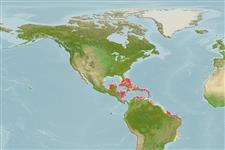
Western Atlantic: southeastern Florida (USA), Bahamas, and Yucatan, Mexico to Lesser Antilles; probably to northern South America. Also Antilles (Ref. 26938).
Größe / Gewicht / Alter
Geschlechtsreife: Lm ? range ? - ? cm
Max length : 6.5 cm TL Männchen/unbestimmt; (Ref. 7251)
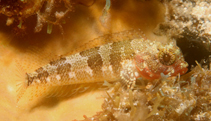
Rückenflossenstacheln (insgesamt) : 19; Afterflossenstacheln: 2; Afterflossenweichstrahlen: 19. Common amongst Labrisomids: small, often elongate fishes. Head usually with cirri or fleshy flaps on anterior nostrils, eyes, and laterally on nape; gill membranes continuous with each other across posteroventral surface of head. Each jaw with an outer row of relatively large, canine-like or incisor-like teeth, often with patches of smaller teeth behind; teeth usually also present on vomer and often on palatines (roof of mouth). Dorsal and anal fins long, frequently highest anteriorly; dorsal-fin spines often flexible, outnumbering segmented dorsal-fin soft rays; 2 usually flexible spines in anal fin; pelvic fins inserted anterior to pectoral-fin bases, with 1 spine not visible externally and only 2 or 3 segmented rays; all fin rays, including those of caudal, unbranched (simple); lateral-line tubes or canals varying from complete (extending entire length of body) to present only on anterior portion of body. Cycloid (smooth to touch) scales present at least posteriorly on body. Body coloration: usually with irregular vertical bands, spots, or marbled pattern. Species distinguished by: specimens 2.8 to 4.0 cm SL; dorsal-fin spines usually 19, segmented anal-fin rays usually 19; length of shortest pelvic-fin ray more than half length of longest ray; pectoral-fin rays usually 13; pelvic-fin soft rays 3 (innermost ray may be reduced in length and folded over middle ray); scales in lateral-line series 40 to 69 (some scales in posterior portion of lateral line may lack sensory tubes, but are included in count) maxillary bone exposed posteriorly; patches of small teeth behind outer row of large teeth in at least upper jaw; palatine teeth present, some distinctly larger than those on vomer; two or more cirri on each side of nape just anterior to dorsal-fin origin; dorsal and anal fins pale or with very faint markings; peritoneum white with scattered large melanophores; opercular ocellus absent (Ref. 52855).
Body shape (shape guide): elongated.
Occurs from rocky and rubble shores with algal mats to reefs and seagrass beds.
Lebenszyklus und Paarungsverhalten
Geschlechtsreife | Fortpflanzung | Ablaichen | Eier | Fruchtbarkeit | Larven
Robins, C.R. and G.C. Ray, 1986. A field guide to Atlantic coast fishes of North America. Houghton Mifflin Company, Boston, U.S.A. 354 p. (Ref. 7251)
IUCN Rote Liste Status (Ref. 130435: Version 2025-2 (Global))
Bedrohung für Menschen
Harmless
Nutzung durch Menschen
Tools
Zusatzinformationen
Download XML
Internet Quellen
Schätzungen auf der Grundlage von Modellen
Bevorzugte Temperatur (Ref.
123201): 26.5 - 28.2, mean 27.5 °C (based on 602 cells).
Phylogenetischer Diversitätsindex (Ref.
82804): PD
50 = 0.5078 [Uniqueness, from 0.5 = low to 2.0 = high].
Bayesian length-weight: a=0.00525 (0.00218 - 0.01265), b=3.08 (2.86 - 3.30), in cm total length, based on LWR estimates for this (Sub)family-body shape (Ref.
93245).
Trophische Ebene (Ref.
69278): 3.6 ±0.6 se; based on size and trophs of closest relatives
Anfälligkeit der Fischerei (Ref.
59153): Low vulnerability (10 of 100).
🛈
Nährstoffe (Ref.
124155): Calcium = 102 [38, 226] mg/100g; Iron = 0.768 [0.385, 1.522] mg/100g; Protein = 19 [18, 20] %; Omega3 = 0.157 [0.075, 0.322] g/100g; Selenium = 9.13 [3.29, 23.91] μg/100g; VitaminA = 139 [36, 568] μg/100g; Zinc = 1.54 [0.86, 2.52] mg/100g (wet weight);