>
Carangiformes (Jacks) >
Carangidae (Jacks and pompanos) > Caranginae
Etymology: Decapterus: Greek, deka = ten + Greek, pteron = wing, fin (Ref. 45335).
Eponymy: Dr Patrick Russell (1727–1805) was a British surgeon and naturalist. [...] (Ref. 128868), visit book page.
More on author: Rüppell.
Ambiente: milieu / zona climatica / distribuzione batimetrica / gamma di distribuzione
Ecologia
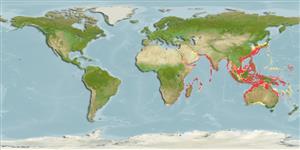
marino benthopelagico; distribuzione batimetrica 40 - 275 m (Ref. 12260). Tropical; 40°N - 36°S, 18°E - 172°E
Indo-West Pacific: East Africa to Japan, the Arafura Sea (Ref. 9819) and Australia. A Lessepsian migrant (Ref. 72453).
Lunghezza alla prima maturità / Dimensione / Peso / Età
Maturità: Lm 16.1, range 14 - 24.5 cm
Max length : 45.0 cm TL maschio/sesso non determinato; (Ref. 9987); common length : 30.0 cm TL maschio/sesso non determinato; (Ref. 9987); peso massimo pubblicato: 110.00 g (Ref. 4883); Età massima riportata: 12 anni (Ref. 5406)
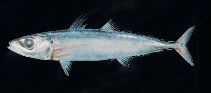
Spine dorsali (totale) : 9; Raggi dorsali molli (totale) : 28 - 31; Spine anali: 3; Raggi anali molli: 25 - 28; Vertebre: 24. Lateral line curved below soft dorsal and with 30-44 strong scutes; color bluish green above, silvery below; caudal fin hyaline to yellowish; dorsal fins hyaline basally, light dusky distally. Opercle with small, black spot; opercular membrane with smooth margin. Snout longer than eye diameter; squarish lower posterior edge of maxilla; upper jaw with small teeth anteriorly; soft dorsal and anal fins relatively low, not falcate; pectoral fin sub falcate. (Other source of data on morphology: Refs. 3131, 3197, 3287).
Body shape (shape guide): fusiform / normal; Cross section: compressed.
Adults dwell from middle to benthic (Ref. 11230), forming large schools in deep water, but occasionally inshore in sheltered bays in small to large groups (Ref. 48635). The most common Decapterus in coastal waters and on open banks of the Indian Ocean. They feed mainly on smaller planktonic invertebrates. Generally marketed fresh, may be dried or salted. Also sold frozen and canned (Ref. 9987).
Paxton, J.R., D.F. Hoese, G.R. Allen and J.E. Hanley, 1989. Pisces. Petromyzontidae to Carangidae. Zoological Catalogue of Australia, Vol. 7. Australian Government Publishing Service, Canberra, 665 p. (Ref. 7300)
Stato della Lista Rossa IUCN (Ref. 130435: Version 2025-2 (Global))
Minaccia per l'uomo
Harmless
Usi umani
Pesca: elevato interesse commerciale; esca: occasionally
Strumenti
Rapporti speciali
Scarica XML
Fonti Internet
Stime basate su modelli
Temperatura preferita (Fonte Biblio.
123201): 16.8 - 27.4, mean 23.2 °C (based on 690 cells).
Indice di diversità filogenetica (Fonte Biblio.
82804): PD
50 = 0.5005 [Uniqueness, from 0.5 = low to 2.0 = high].
Bayesian length-weight: a=0.01072 (0.00938 - 0.01224), b=2.97 (2.94 - 3.00), in cm total length, based on LWR estimates for this species (Ref.
93245).
Livello trofico (Fonte Biblio.
69278): 3.7 ±0.4 se; based on diet studies.
Generation time: 1.5 (1.2 - 1.7) years. Estimated as median ln(3)/K based on 28
growth studies.
Resilienza (Fonte Biblio.
120179): Alto, tempo minimo di raddoppiamento della popolazione meno di 15 mesi (K=0.73; assumed tm=1-2; Fec>10,000; tmax=12).
Prior r = 0.68, 95% CL = 0.45 - 1.03, Based on 16 data-limited stock assessments.
Vulnerabilità della pesca (Ref.
59153): Low vulnerability (24 of 100).
🛈
Vulnerabilità climatica (Ref.
125649): Moderate vulnerability (42 of 100).
🛈
Nutrienti (Ref.
124155): Calcium = 394 [150, 1,297] mg/100g; Iron = 3.4 [1.2, 8.1] mg/100g; Protein = 19.4 [18.0, 20.9] %; Omega3 = 0.359 [0.161, 0.825] g/100g; Selenium = 148 [46, 441] μg/100g; VitaminA = 10.8 [2.3, 46.9] μg/100g; Zinc = 1.31 [0.73, 2.52] mg/100g (wet weight); based on
nutrient studies.