>
Blenniiformes (Blennies) >
Chaenopsidae (Pike-, tube- and flagblennies)
Etymology: Neoclinus: Greek,neos = new + Greek, klinein, kline = sloping and bed, due to the four apophyses of sphenoid bone (Ref. 45335); blanchardi: Neoclinus is formed from 2 Greek words meaning "new Clinus"; blanchardi honors S.B. Blanchard, who discovered the species in San Diego and passed it on to Girard, its describer (Ref. 43439).
Eponymy: Dr S B Blanchard discovered and collected the species off San Diego (1849) and passed it on to Girard. We have failed to find any biographical data for Dr Blanchard. (Ref. 128868), visit book page.
More on author: Girard.
Ambiente: milieu / zona climática / intervalo de profundidade / gama de distribuição
Ecologia
marinhas demersal; intervalo de profundidade 3 - 73 m (Ref. 43439). Subtropical; 38°N - 27°N, 123°W - 114°W
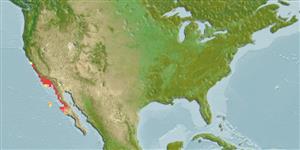
Eastern Pacific: San Francisco in California, USA to central Baja California, Mexico.
Tamanho / Peso / Idade
Maturidade: Lm ? range ? - ? cm
Max length : 30.0 cm TL macho/indeterminado; (Ref. 2850); Idade máx. registada: 6 anos (Ref. 43439)
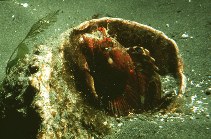
Usually occurs on exposed coast, on sand or hard mud bottom below low tide, rarer in bays. Usually found inside objects, especially mollusk shells, clam burrows and bottles. Demersal spawners in nearshore habitats (Ref. 56049). Female deposits eggs in clam burrows or under rocks, male guards them.
Ciclo de vida e comportamento de acasalamento
Maturidade | Reprodução | Desova | Ovos | Fecundidade | Larvas
Females lay eggs in abandoned boring clam holes, under rocks, in beer containers, and other containers. Males guard the eggs until they hatch (Ref. 43439).
Eschmeyer, W.N., E.S. Herald and H. Hammann, 1983. A field guide to Pacific coast fishes of North America. Boston (MA, USA): Houghton Mifflin Company. xii+336 p. (Ref. 2850)
Categoria na Lista Vermelha da IUCN (Ref. 130435: Version 2025-2 (Global))
Ameaça para o homem
Harmless
Utilização humana
Ferramentas
Relatórios especiais
Descarregue XML
Fontes da internet
Estimativas baseadas em modelos
Temperatura preferida (Ref.
123201): 9.7 - 19, mean 14.5 °C (based on 20 cells).
Índice de diversidade filogenética (Ref.
82804): PD
50 = 0.5005 [Uniqueness, from 0.5 = low to 2.0 = high].
Bayesian length-weight: a=0.00525 (0.00224 - 0.01232), b=3.07 (2.86 - 3.28), in cm total length, based on LWR estimates for this (Sub)family-body shape (Ref.
93245).
Nível Trófico (Ref.
69278): 2.2 ±0.2 se; based on size and trophs of closest relatives
Resiliência (Ref.
120179): Médio, tempo mínimo de duplicação da população 1,4 - 4,4 anos (tmax=6).
Vulnerabilidade da pesca (Ref.
59153): Low vulnerability (20 of 100).
🛈