>
Blenniiformes (Blennies) >
Blenniidae (Combtooth blennies) > Salariinae
Etymology: Entomacrodus: Greek, ento = inside + Greek, makros = big + Greek, odous = teeth (Ref. 45335).
More on author: Gill.
Umwelt: Milieu / Klimazone / Tiefenbereich / Verbreitungsgebiet
Ökologie
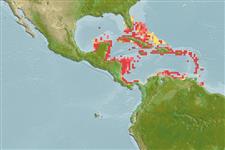
seewasser riff-verbunden; tiefenbereich 0 - 6 m (Ref. 9710), usually 0 - 3 m (Ref. 13628). Tropical; 32°N - 7°N, 92°W - 59°W
Western Atlantic: Bermuda, southern Florida (USA), and Bahamas to northern South America.
Größe / Gewicht / Alter
Geschlechtsreife: Lm ? range ? - ? cm
Max length : 10.0 cm TL Männchen/unbestimmt; (Ref. 7251)
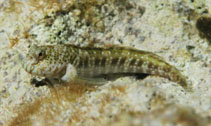
Rückenflossenstacheln (insgesamt) : 13; Rückenflossenweichstrahlen (insgesamt) : 14 - 15; Afterflossenstacheln: 2; Afterflossenweichstrahlen: 15 - 17; Wirbelzahl: 34. Olivaceous with 7 short dark brown double bars on side of body and rows of small pale blue spots (Ref. 13442).
Body shape (shape guide): elongated.
Facultative air-breathing (Ref. 126274); Adults occur in intertidal areas (Ref. 31184), like tide pools, rocky slopes, and places where there are boulders on the bottom (Ref. 5521). Actively shuttle back and forth between rock-pools and air (Ref. 31184). They breathe air (Ref. 31184) and can remain out of water for up to 2 hours if kept moist (Ref. 51276). Feed mainly on algae (Ref. 13442). Oviparous. Eggs are demersal and adhesive (Ref. 205), and are attached to the substrate via a filamentous, adhesive pad or pedestal (Ref. 94114). Larvae are planktonic, often found in shallow, coastal waters (Ref. 94114).
Lebenszyklus und Paarungsverhalten
Geschlechtsreife | Fortpflanzung | Ablaichen | Eier | Fruchtbarkeit | Larven
Oviparous, distinct pairing (Ref. 205).
Robins, C.R. and G.C. Ray, 1986. A field guide to Atlantic coast fishes of North America. Houghton Mifflin Company, Boston, U.S.A. 354 p. (Ref. 7251)
IUCN Rote Liste Status (Ref. 130435: Version 2025-2 (Global))
Bedrohung für Menschen
Harmless
Nutzung durch Menschen
Fischereien: nicht kommerziell; Aquarium: Kommerziell
Tools
Zusatzinformationen
Download XML
Internet Quellen
Schätzungen auf der Grundlage von Modellen
Bevorzugte Temperatur (Ref.
123201): 26.5 - 28.2, mean 27.5 °C (based on 532 cells).
Phylogenetischer Diversitätsindex (Ref.
82804): PD
50 = 0.5000 [Uniqueness, from 0.5 = low to 2.0 = high].
Bayesian length-weight: a=0.00776 (0.00354 - 0.01702), b=3.00 (2.81 - 3.19), in cm total length, based on LWR estimates for this (Sub)family-body shape (Ref.
93245).
Trophische Ebene (Ref.
69278): 2.0 ±0.0 se; based on diet studies.
Widerstandsfähigkeit (Ref.
120179): hoch, Verdopplung der Population dauert weniger als 15 Monate. (Preliminary K or Fecundity.).
Anfälligkeit der Fischerei (Ref.
59153): Low vulnerability (10 of 100).
🛈
Nährstoffe (Ref.
124155): Calcium = 165 [80, 291] mg/100g; Iron = 0.868 [0.480, 1.563] mg/100g; Protein = 17.9 [16.7, 19.1] %; Omega3 = 0.0751 [, ] g/100g; Selenium = 20 [9, 47] μg/100g; VitaminA = 114 [27, 469] μg/100g; Zinc = 2.71 [1.75, 4.02] mg/100g (wet weight);