>
Blenniiformes (Blennies) >
Blenniidae (Combtooth blennies) > Salariinae
Etymology: Hypleurochilus: Greek, hypo = under + Greek, pleura = in the side of + Greek, cheilos = lip.
Umwelt: Milieu / Klimazone / Tiefenbereich / Verbreitungsgebiet
Ökologie
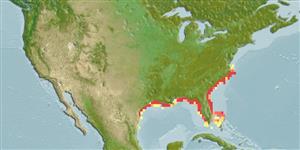
seewasser riff-verbunden. Subtropical; 37°N - 24°N, 98°W - 74°W
Western Atlantic: North Carolina to Texas, including southern Florida in the USA. Recorded from coast of Central and South America (to Brazil), but these records probably are not of this species.
Größe / Gewicht / Alter
Geschlechtsreife: Lm ? range ? - ? cm
Max length : 10.0 cm TL Männchen/unbestimmt; (Ref. 7251)
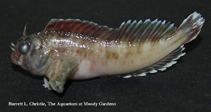
Rückenflossenstacheln (insgesamt) : 12; Afterflossenstacheln: 2; Afterflossenweichstrahlen: 17. Species distinguished by: preopercular sensory pore series with 1 pore (sometimes 2) at each position (New Jersey to northeastern Florida); dorsal fin not separated into 2 portions by deep notch; dorsal-fin spines usually 12, the last easy to see; total dorsal-fin elements 25 to 30; caudal fin uniformly pigmented or mottled with dark spots; segmented caudal-fin soft rays usually 13; segmented anal-fin rays usually 17; pelvic fins with 1 spine and 4 soft rays; pectoral-fin soft rays usually 13 or 14; an enlarged canine tooth present posteriorly on both sides of 1 or both jaws (sometimes absent on 1 side); no teeth on vomer; gill openings not continuous, each restricted to side of head, extending ventrally to about midlevel of pectoral-fin base or further (may extend completely around lower side of head and form common opening with gill opening of opposite side); cirri present only on eyes; ventral edge of upper lip smooth; lateral line never consisting of 2 disconnected, overlapping portions. Common amongst Blenniids: small, slender fishes, largest species to about 13 cm SL, most under 7.5 cm SL. Eyes high on sides of head; mouth ventral, upper jaw not protractile. A single row of incisor-like teeth in each jaw and often an enlarged canine-like tooth posteriorly on each side of lower jaw and sometimes upper jaw; no teeth on palatines. Dorsal and anal fins long, their spines usually flexible; dorsal fin with fewer spines than segmented (soft) rays; 2 spines in anal fin, scarcely differentiated from the segmented rays, the first not visible in females, both often supporting fleshy, bulbous, rugose swellings at their tips in males; pelvic fins inserted anterior to base of pectoral fins, with 1 spine (not visible) and segmented rays; all segmented fin rays, except those of caudal fin, unbranched (simple), caudal-fin rays of adults branched. All species lack scales (Ref.52855).
Body shape (shape guide): elongated.
Oviparous. Eggs are demersal and adhesive (Ref. 205), and are attached to the substrate via a filamentous, adhesive pad or pedestal (Ref. 94114). Larvae are planktonic, often found in shallow, coastal waters (Ref. 94114).
Lebenszyklus und Paarungsverhalten
Geschlechtsreife | Fortpflanzung | Ablaichen | Eier | Fruchtbarkeit | Larven
Oviparous, distinct pairing (Ref. 205).
Robins, C.R. and G.C. Ray, 1986. A field guide to Atlantic coast fishes of North America. Houghton Mifflin Company, Boston, U.S.A. 354 p. (Ref. 7251)
IUCN Rote Liste Status (Ref. 130435: Version 2025-2 (Global))
Bedrohung für Menschen
Harmless
Nutzung durch Menschen
Fischereien: nicht kommerziell
Tools
Zusatzinformationen
Download XML
Internet Quellen
Schätzungen auf der Grundlage von Modellen
Bevorzugte Temperatur (Ref.
123201): 23.2 - 26.1, mean 24 °C (based on 136 cells).
Phylogenetischer Diversitätsindex (Ref.
82804): PD
50 = 0.5005 [Uniqueness, from 0.5 = low to 2.0 = high].
Bayesian length-weight: a=0.00776 (0.00354 - 0.01702), b=3.00 (2.81 - 3.19), in cm total length, based on LWR estimates for this (Sub)family-body shape (Ref.
93245).
Trophische Ebene (Ref.
69278): 3.2 ±0.3 se; based on size and trophs of closest relatives
Widerstandsfähigkeit (Ref.
120179): hoch, Verdopplung der Population dauert weniger als 15 Monate. (Preliminary K or Fecundity.).
Anfälligkeit der Fischerei (Ref.
59153): Low vulnerability (10 of 100).
🛈
Nährstoffe (Ref.
124155): Calcium = 94.3 [35.8, 179.7] mg/100g; Iron = 0.803 [0.427, 1.498] mg/100g; Protein = 18.9 [17.7, 20.0] %; Omega3 = 0.145 [0.073, 0.273] g/100g; Selenium = 11.4 [4.8, 26.9] μg/100g; VitaminA = 78.7 [21.0, 293.6] μg/100g; Zinc = 1.46 [0.87, 2.30] mg/100g (wet weight);