>
Blenniiformes (Blennies) >
Blenniidae (Combtooth blennies) > Salariinae
Etymology: Hypsoblennius: Greek, hypsi = high + Greek, blennios = mucus (Ref. 45335).
Eponymy: Nicholas Marcellus Hentz (1797–1856) was a French-born American entomologist, arachnologist and teacher. [...] (Ref. 128868), visit book page.
More on author: Lesueur.
Môi trường: môi trường / vùng khí hậu / Mức độ sâu / phạm vi phân phối
Sinh thái học
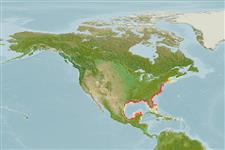
biển cùng sống ở rạn san hô. Temperate; 46°N - 18°N, 98°W - 62°W
Western Atlantic: New Jersey (occasionally Nova Scotia in Canada) to Texas, including southern Florida in USA.
Bộ gần gũi / Khối lượng (Trọng lượng) / Tuổi
Chín muồi sinh dục: Lm ? range ? - ? cm
Max length : 10.0 cm TL con đực/không giới tính; (Ref. 7251)
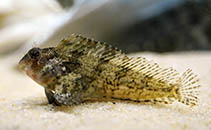
Các tia vây lưng cứng (tổng cộng) : 11 - 13; Các vây lưng mềm (tổng cộng) : 13 - 16; Tia cứng vây hậu môn: 2. Gill opening extending ventrally to opposite 7th-11th pectoral-fin ray; segmented dorsal-fin rays 13-16; segmented pelvic-fin rays 3; last dorsal-fin spine 8.5-15.5% SL; dorsal-fin spines robust and stiff; no elongate fleshy flap present posteriorly on lower lip; infraorbital bones 5-5; upper lip without free dorsal margin extending around snout; fleshy lobes of lower lip almost linear in lateral view and separated anterioventrally by a broad smooth area; bony interorbital width comparatively wider; dark spot usually present in spinous dorsal fin and centered on second spine; mandibular pores 4.
Body shape (shape guide): elongated; Cross section: oval.
Adults inhabit oyster reefs and rocky shores. Oviparous. Eggs are demersal and adhesive (Ref. 205), and are attached to the substrate via a filamentous, adhesive pad or pedestal (Ref. 94114). Larvae are planktonic, often found in shallow, coastal waters (Ref. 94114).
Vòng đời và hành vi giao phối
Chín muồi sinh dục | Sự tái sinh sản | Đẻ trứng | Các trứng | Sự sinh sản | Ấu trùng
Oviparous, distinct pairing (Ref. 205).
Robins, C.R. and G.C. Ray, 1986. A field guide to Atlantic coast fishes of North America. Houghton Mifflin Company, Boston, U.S.A. 354 p. (Ref. 7251)
Tình trạng Sách đỏ IUCN (Ref. 130435: Version 2025-2 (Global))
Mối đe dọa đối với con người
Harmless
Sử dụng của con người
Các nghề cá: không ích lợi (thú vị)
Các công cụ
Báo cáo đặc biệt
Tải xuống XML
Các nguồn internet
Ước tính dựa trên mô hình
Nhiệt độ ưa thích (Tài liệu tham khảo
123201): 12.5 - 26.1, mean 23.7 °C (based on 188 cells).
Chỉ số đa dạng phát sinh loài (Tài liệu tham khảo
82804): PD
50 = 0.5000 [Uniqueness, from 0.5 = low to 2.0 = high].
Bayesian length-weight: a=0.00776 (0.00354 - 0.01702), b=3.00 (2.81 - 3.19), in cm total length, based on LWR estimates for this (Sub)family-body shape (Ref.
93245).
Mức dinh dưỡng (Tài liệu tham khảo
69278): 2.8 ±0.2 se; based on size and trophs of closest relatives
Thích nghi nhanh (Tài liệu tham khảo
120179): Chiêù cao, thời gian nhân đôi của chủng quần tối thiểu là dưới 15 tháng (Preliminary K or Fecundity.).
Sự dễ bị tổn thương của nghề đánh cá (Ref.
59153): Low vulnerability (10 of 100).
🛈
Chất dinh dưỡng (Ref.
124155): Calcium = 51.5 [16.8, 99.3] mg/100g; Iron = 0.286 [0.140, 0.560] mg/100g; Protein = 18.4 [17.1, 19.7] %; Omega3 = 0.233 [0.105, 0.504] g/100g; Selenium = 5.02 [1.83, 13.23] μg/100g; VitaminA = 86 [18, 428] μg/100g; Zinc = 1.1 [0.7, 1.8] mg/100g (wet weight);