Ambiente: milieu / zona climática / intervalo de profundidade / gama de distribuição
Ecologia
marinhas demersal. Tropical; 34°N -
Western Atlantic: South Carolina to Texas, including southern Florida in the USA.
Tamanho / Peso / Idade
Maturidade: Lm ? range ? - ? cm
Max length : 10.0 cm TL macho/indeterminado; (Ref. 7251)
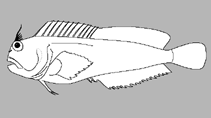
Espinhos dorsais (total) : 11 - 13; Raios dorsais moles (total) : 13 - 15; Espinhos anais: 2; Raios anais moles: 14 - 17. Gill opening extending ventrally to opposite 5th-11th pectoral-fin ray; segmented dorsal-fin rays 13-15; segmented pelvic-fin rays 3; last dorsal-fin spine 8.5-15.5% SL; dorsal-fin spines robust and stiff; no elongate fleshy flap present posteriorly on lower lip; infraorbital bones 5; upper lip with free dorsal margin extending around snout; fleshy lobes of lower lip almost semicircular in lateral view and separated anterioventrally by a broad shield-shaped lobe; bony interorbital width comparatively narrower; dark spot usually absent in spinous dorsal fin, but if present centered on third spine; mandibular pores 3.
Body shape (shape guide): elongated; Cross section: oval.
Herbivorous, with short chisel-like teeth used to scrape algae and detritus from surfaces (Ref. 94105). Oviparous. Eggs are demersal and adhesive (Ref. 205), and are attached to the substrate via a filamentous, adhesive pad or pedestal (Ref. 94114). Larvae are planktonic, often found in shallow, coastal waters (Ref. 94114). Migratory behaviour is undetermined (Ref. 126106).
Ciclo de vida e comportamento de acasalamento
Maturidade | Reprodução | Desova | Ovos | Fecundidade | Larvas
Oviparous, distinct pairing (Ref. 205).
Robins, C.R. and G.C. Ray, 1986. A field guide to Atlantic coast fishes of North America. Houghton Mifflin Company, Boston, U.S.A. 354 p. (Ref. 7251)
Categoria na Lista Vermelha da IUCN (Ref. 130435: Version 2025-2 (Global))
Ameaça para o homem
Harmless
Utilização humana
Pescarias: sem interesse
Ferramentas
Relatórios especiais
Descarregue XML
Fontes da internet
Estimativas baseadas em modelos
Índice de diversidade filogenética (Ref.
82804): PD
50 = 0.5000 [Uniqueness, from 0.5 = low to 2.0 = high].
Bayesian length-weight: a=0.00776 (0.00354 - 0.01702), b=3.00 (2.81 - 3.19), in cm total length, based on LWR estimates for this (Sub)family-body shape (Ref.
93245).
Nível Trófico (Ref.
69278): 2.8 ±0.2 se; based on size and trophs of closest relatives
Resiliência (Ref.
120179): Elevada, tempo mínimo de duplicação da população menor que 15 meses (Preliminary K or Fecundity.).
Vulnerabilidade da pesca (Ref.
59153): Low vulnerability (10 of 100).
🛈