>
Blenniiformes (Blennies) >
Blenniidae (Combtooth blennies) > Salariinae
Etymology: Lupinoblennius: Latin, lupinus, lupus = wolf + Greek, blennios = mucus (Ref. 45335).
Eponymy: John Treadwell Nichols (1883–1958) was an American ichthyologist, mammalogist and ornithologist. [...] (Ref. 128868), visit book page.
Ambiente: milieu / zona climatica / distribuzione batimetrica / gamma di distribuzione
Ecologia
marino; salmastro associati a barriera corallina. Subtropical
Western Atlantic: northeastern Florida, Gulf of Mexico (known only from near Englewood, Florida) and Texas in USA, and northeastern Mexico.
Dimensione / Peso / Età
Maturità: Lm ? range ? - ? cm
Max length : 6.0 cm TL maschio/sesso non determinato; (Ref. 7251)
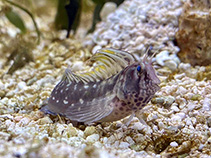
Spine dorsali (totale) : 12; Spine anali: 2. Species distinguished by: anterior dorsal-fin spines longer than posterior rays (greatly elongate in males); dorsal fin not separated into 2 portions by deep notch; dorsal-fin spines usually 12, the last easy to see; total dorsal-fin elements 25 to 30; pectoral-fin soft rays usually 13; total dorsal-fin elements 25 to 27; segmented caudal-fin soft rays usually 13; segmented pelvic-fin rays 3 or 4; cirri present only on eyes; a single, simple cirrus on each eye; ventral edge of upper lip smooth; gill opening continuous from one side of head to other across ventral surface of head, extending ventrally to about midlevel of pectoral-fin base or further (may extend completely around lower side of head and form common opening with gill opening of opposite side); no teeth on vomer; lateral line never consisting of 2 disconnected, overlapping portions. Common amongst Blenniids: small, slender fishes, largest species to about 13 cm SL, most under 7.5 cm SL. Eyes high on sides of head; mouth ventral, upper jaw not protractile. A single row of incisor-like teeth in each jaw and often an enlarged canine-like tooth posteriorly on each side of lower jaw and sometimes upper jaw; no teeth on palatines. Dorsal and anal fins long, their spines usually flexible; dorsal fin with fewer spines than segmented (soft) rays; 2 spines in anal fin, scarcely differentiated from the segmented rays, the first not visible in females, both often supporting fleshy, bulbous, rugose swellings at their tips in males; pelvic fins inserted anterior to base of pectoral fins, with 1 spine (not visible) and segmented rays; all segmented fin rays, except those of caudal fin, unbranched (simple), caudal-fin rays of adults branched. All species lack scales (Ref.52855).
Body shape (shape guide): elongated.
Oviparous. Eggs are demersal and adhesive (Ref. 205), and are attached to the substrate via a filamentous, adhesive pad or pedestal (Ref. 94114). Larvae are planktonic, often found in shallow, coastal waters (Ref. 94114).
Ciclo vitale e comportamento di accoppiamento
Maturità | Riproduzione | Deposizione | Uova | Fecondità | Larve
Oviparous, distinct pairing (Ref. 205).
Robins, C.R. and G.C. Ray, 1986. A field guide to Atlantic coast fishes of North America. Houghton Mifflin Company, Boston, U.S.A. 354 p. (Ref. 7251)
Stato della Lista Rossa IUCN (Ref. 130435: Version 2025-2 (Global))
Minaccia per l'uomo
Harmless
Usi umani
Pesca: di nessun interesse
Strumenti
Rapporti speciali
Scarica XML
Fonti Internet
Stime basate su modelli
Indice di diversità filogenetica (Fonte Biblio.
82804): PD
50 = 0.6250 [Uniqueness, from 0.5 = low to 2.0 = high].
Bayesian length-weight: a=0.00776 (0.00354 - 0.01702), b=3.00 (2.81 - 3.19), in cm total length, based on LWR estimates for this (Sub)family-body shape (Ref.
93245).
Resilienza (Fonte Biblio.
120179): Alto, tempo minimo di raddoppiamento della popolazione meno di 15 mesi (Preliminary K or Fecundity.).
Vulnerabilità della pesca (Ref.
59153): Low vulnerability (10 of 100).
🛈