>
Perciformes/Zoarcoidei (Eelpouts and pricklebacks) >
Lumpenidae (Eel pricklebacks)
Etymology: Leptoclinus: Greek, leptos = thin + Greek, klinein, kline = sloping and bed, due to the four apophyses of sphenoid bone (Ref. 45335).
Environnement : milieu / zone climatique / profondeur / gamme de distribution
Écologie
marin démersal; profondeur 2 - 607 m (Ref. 58426). Polar; -2°C - 2°C (Ref. 120227); 79°N - 43°N, 180°W - 180°E (Ref. 86838)
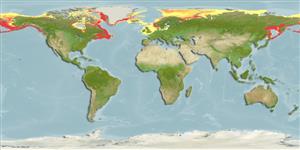
Circumpolar: Arctic to temperate waters; northern hemisphere. Arctic Alaska to Sea of Okhotsk, northern Sea of Japan, Unalaska Island in the Aleutian chain and Puget Sound, Washington, USA. North Atlantic: Arctic to Labrador in Canada; along Scandinavia from Skagerrak to Finnmarken, common at Murmansk, White Sea, Iceland and Greenland (Ref. 10006). The Pacific form is sometimes treated as a subspecies Leptoclinus maculatus diaphanocarus (Ref. 51666).
Longueur à la première maturité / Taille / Poids / Âge
Maturité: Lm 12.5, range 13 - 13 cm
Max length : 20.0 cm TL mâle / non sexé; (Ref. 35388)
Description synthétique
Clés d'identification | Morphologie | Morphométrie
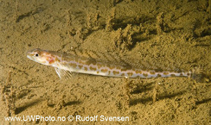
Épines dorsales (Total) : 57 - 60; Rayons mous dorsaux (Total) : 0; Épines anales: 1 - 2; Rayons mous anaux: 34 - 36. Caudal rounded; lower 5 rays of pectorals greatly lengthened and exserted (Ref. 6885). Color greyish - yellow with dark irregular spots (Ref. 35388).
Body shape (shape guide): elongated.
Adults, juveniles, and late postlarvae are found on sandy and mud to pebble bottoms, usually in less than 170 meters (Ref. 2850, 51666, 120227), while early postlarvae are pelagic (Ref. 120227). Food consists of polychaetes and crustaceans (Ref. 10571). They are an important prey for pelagic (as larvae) and benthic (as adults) predators (Ref. 120226). Sexual dimorphism is more pronounced after maturation with males displaying faster somatic growth (Ref. 120226). This marked dimorphism may well be linked with behavioral dissimilarities between males and
females, and is most likely associated with different roles during the breeding season with only adult males have large canines at the tip of upper jaw. It is assumed that males are territorial and defend their spawning sites, whereasfemales guard eggs within her partner’s territory (Ref. 128434).
Males exhibit territorial defence (Ref. 120226).
Eschmeyer, W.N., E.S. Herald and H. Hammann, 1983. A field guide to Pacific coast fishes of North America. Boston (MA, USA): Houghton Mifflin Company. xii+336 p. (Ref. 2850)
Statut dans la liste rouge de l'IUCN (Ref. 130435: Version 2025-2 (Global))
Menace pour l'homme
Harmless
Utilisations par l'homme
Pêcheries: bycatch
Outils
Articles particuliers
Télécharger en XML
Sources Internet
Estimations basées sur des modèles
Température préférée (Réf.
123201): 0.2 - 7, mean 2.3 °C (based on 1058 cells).
Indice de diversité phylogénétique (Réf.
82804): PD
50 = 1.0005 [Uniqueness, from 0.5 = low to 2.0 = high].
Bayesian length-weight: a=0.00269 (0.00146 - 0.00495), b=3.06 (2.89 - 3.23), in cm total length, based on LWR estimates for this species & (Sub)family-body (Ref.
93245).
Niveau trophique (Réf.
69278): 3.3 ±0.39 se; based on food items.
Generation time: 11.1 ( na - na) years. Estimated as median ln(3)/K based on 2
growth studies.
Résilience (Réf.
120179): Faible, temps minimum de doublement de population : 4,5 à 14 années (tm=7; tmax=12; K=0.099; Fec=931).
Vulnérabilité de la pêche (Ref.
59153): High vulnerability (59 of 100).
🛈
Nutriments (Ref.
124155): Calcium = 22.3 [4.8, 93.2] mg/100g; Iron = 0.512 [0.172, 1.359] mg/100g; Protein = 16.8 [14.9, 18.9] %; Omega3 = 0.288 [0.112, 0.751] g/100g; Selenium = 9.62 [3.01, 35.80] μg/100g; VitaminA = 35.4 [6.5, 194.5] μg/100g; Zinc = 0.57 [0.29, 1.21] mg/100g (wet weight);