Umwelt: Milieu / Klimazone / Tiefenbereich / Verbreitungsgebiet
Ökologie
seewasser demersal; tiefenbereich 0 - 73 m (Ref. 50610). Temperate
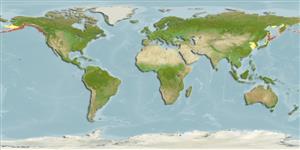
Eastern Pacific: Bering Sea coast of Alaska and the Aleutian Islands to Crescent City, northern California, USA. Early records might be misleading since Pholis laeta was once considered identical to Pholis ornatus and was recorded as Pholis ornatus (Ref. 4925).
Größe / Gewicht / Alter
Geschlechtsreife: Lm ? range ? - ? cm
Max length : 25.0 cm TL Männchen/unbestimmt; (Ref. 2850)
Kurzbeschreibung
Bestimmungsschlüssel | Morphologie | Morphometrie
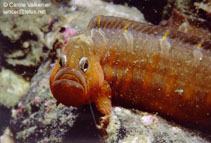
Rückenflossenstacheln (insgesamt) : 74 - 80; Rückenflossenweichstrahlen (insgesamt) : 0; Afterflossenstacheln: 2; Afterflossenweichstrahlen: 35 - 37. Caudal rounded. Pelvic fins minute.
Body shape (shape guide): eel-like.
Facultative air-breathing in the genus (Ref. 126274); Frequently in intertidal areas, in tide pools or under rocks protected by seaweeds (Ref. 2850). May remain out of water under rocks or seaweed (Ref. 31184). Probably feeds on small crustaceans and marine worms (Ref. 28499). Breathes air when out of water (Ref. 31184).
Lebenszyklus und Paarungsverhalten
Geschlechtsreife | Fortpflanzung | Ablaichen | Eier | Fruchtbarkeit | Larven
Male and female coil around the egg ball (Ref. 58332).
Eschmeyer, W.N., E.S. Herald and H. Hammann, 1983. A field guide to Pacific coast fishes of North America. Boston (MA, USA): Houghton Mifflin Company. xii+336 p. (Ref. 2850)
IUCN Rote Liste Status (Ref. 130435: Version 2025-2 (Global))
Bedrohung für Menschen
Harmless
Nutzung durch Menschen
Fischereien: kommerziell; Aquarium: Öffentliche Aquarien
Tools
Zusatzinformationen
Download XML
Internet Quellen
Schätzungen auf der Grundlage von Modellen
Bevorzugte Temperatur (Ref.
123201): 4.1 - 13.5, mean 8.9 °C (based on 232 cells).
Phylogenetischer Diversitätsindex (Ref.
82804): PD
50 = 0.5005 [Uniqueness, from 0.5 = low to 2.0 = high].
Bayesian length-weight: a=0.00162 (0.00068 - 0.00384), b=3.19 (2.99 - 3.39), in cm total length, based on LWR estimates for this (Sub)family-body shape (Ref.
93245).
Trophische Ebene (Ref.
69278): 3.3 ±0.39 se; based on food items.
Widerstandsfähigkeit (Ref.
120179): hoch, Verdopplung der Population dauert weniger als 15 Monate. (Preliminary K or Fecundity.).
Anfälligkeit der Fischerei (Ref.
59153): Low vulnerability (15 of 100).
🛈