>
Perciformes/Zoarcoidei (Eelpouts and pricklebacks) >
Zaproridae (Prowfish)
Etymology: silenus: Named after Silenus, a drunkard demigod who fell in a marsh on a revel and became covered with slime (Ref. 6885).
Eponymy: Silenus, in Greek mythology, was a companion and tutor to the wine-god Dionysus. He was usually drunk, and the binomial may have been inspired by the fact that the holotype was preserved in alcohol. (Ref. 128868), visit book page.
More on author: Jordan.
Environnement : milieu / zone climatique / profondeur / gamme de distribution
Écologie
marin démersal; profondeur 0 - 675 m (Ref. 50550), usually 0 - 500 m (Ref. 28981). Boreal; 0°C - 4°C (Ref. 56462); 66°N - 34°N
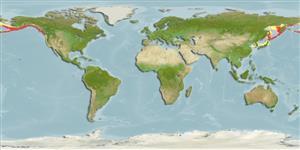
North Pacific: Hokkaido, Japan and western Kamchatka, Russia to Navarin Canyon in the Bering Sea, Attu Island in the Aleutian chain and San Miguel Island, California, USA.
Longueur à la première maturité / Taille / Poids / Âge
Maturité: Lm 57.0 range ? - ? cm
Max length : 88.0 cm TL mâle / non sexé; (Ref. 2850); common length : 42.9 cm TL mâle / non sexé; (Ref. 56462); poids max. publié: 7.0 kg (Ref. 56462); âge max. reporté: 9 années (Ref. 56462)
Description synthétique
Clés d'identification | Morphologie | Morphométrie
Épines dorsales (Total) : 54 - 57; Rayons mous dorsaux (Total) : 0; Épines anales: 0; Rayons mous anaux: 29 - 30. Caudal rounded.
Body shape (shape guide): short and / or deep; Cross section: compressed.
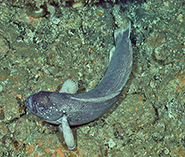
Adults occur near bottom (Ref. 2850). Young to 7.2 cm are pelagic or bathypelagic, usually associated with jellyfish (Ref. 6885). Juveniles take shelter under the medusae and are often mistaken for medusafish Icichthys lockingtoni (Ref. 50276).
Cycle de vie et comportement reproducteur
Maturité | Reproduction | Frai | Œufs | Fécondité | Larves
Eschmeyer, W.N., E.S. Herald and H. Hammann, 1983. A field guide to Pacific coast fishes of North America. Boston (MA, USA): Houghton Mifflin Company. xii+336 p. (Ref. 2850)
Statut dans la liste rouge de l'IUCN (Ref. 130435: Version 2025-2 (Global))
Menace pour l'homme
Harmless
Utilisations par l'homme
Pêcheries: pêcheries vivrières
Outils
Articles particuliers
Télécharger en XML
Sources Internet
Estimations basées sur des modèles
Température préférée (Réf.
123201): 1.4 - 8.9, mean 4.7 °C (based on 1470 cells).
Indice de diversité phylogénétique (Réf.
82804): PD
50 = 1.5000 [Uniqueness, from 0.5 = low to 2.0 = high].
Bayesian length-weight: a=0.01738 (0.00680 - 0.04443), b=2.97 (2.75 - 3.19), in cm total length, based on LWR estimates for this (Sub)family-body shape (Ref.
93245).
Niveau trophique (Réf.
69278): 3.7 ±0.1 se; based on diet studies.
Generation time: 6.1 ( na - na) years. Estimated as median ln(3)/K based on 1
growth studies.
Résilience (Réf.
120179): Faible, temps minimum de doublement de population : 4,5 à 14 années (tm= 5.1; K= 0.18; tmax=9;).
Vulnérabilité de la pêche (Ref.
59153): Moderate to high vulnerability (54 of 100).
🛈
Nutriments (Ref.
124155): Calcium = 17.6 [9.1, 33.0] mg/100g; Iron = 0.374 [0.139, 0.762] mg/100g; Protein = 15.8 [12.9, 19.4] %; Omega3 = 0.282 [0.150, 0.532] g/100g; Selenium = 22 [9, 54] μg/100g; VitaminA = 4.75 [0.88, 24.05] μg/100g; Zinc = 0.289 [0.193, 0.435] mg/100g (wet weight); based on
nutrient studies.