>
Carangiformes (Jacks) >
Carangidae (Jacks and pompanos) > Caranginae
Etymology: Selaroides: A Malay vernacular name, ikan selar + Greek, suffix, oides = similar to.
More on author: Cuvier.
Umwelt: Milieu / Klimazone / Tiefenbereich / Verbreitungsgebiet
Ökologie
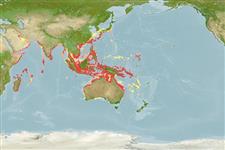
seewasser; brackwasser riff-verbunden; amphidrom (Ref. 51243); tiefenbereich 1 - 50 m (Ref. 90102). Tropical; 39°N - 34°S, 49°E - 170°E (Ref. 54888)
Indo-West Pacific: Persian Gulf to the Philippines, north to Japan, south to the Arafura Sea (Ref. 9819) and Australia (Ref. 3287).
Länge bei der ersten Reifung / Größe / Gewicht / Alter
Geschlechtsreife: Lm 11.9, range 10 - ? cm
Max length : 22.0 cm TL Männchen/unbestimmt; (Ref. 28620); common length : 15.0 cm TL Männchen/unbestimmt; (Ref. 9137); max. veröff. Gewicht: 625.00 g (Ref. 4883)
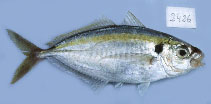
Rückenflossenstacheln (insgesamt) : 9; Rückenflossenweichstrahlen (insgesamt) : 24 - 26; Afterflossenstacheln: 3; Afterflossenweichstrahlen: 21 - 23.
Body shape (shape guide): fusiform / normal; Cross section: compressed.
Adults occur in inshore waters of the continental shelf (Ref. 7300). They form large demersal schools over soft bottom habitats at depths shallower than 50 m. Sometimes they ascend into freshwater reaches like the freshwater tidal zone in the Mekong delta (Ref. 12693). Ostracods, gastropods and euphausiids are common prey but small fish are also taken.
Paxton, J.R., D.F. Hoese, G.R. Allen and J.E. Hanley, 1989. Pisces. Petromyzontidae to Carangidae. Zoological Catalogue of Australia, Vol. 7. Australian Government Publishing Service, Canberra, 665 p. (Ref. 7300)
IUCN Rote Liste Status (Ref. 130435: Version 2025-2 (Global))
Bedrohung für Menschen
Harmless
Nutzung durch Menschen
Fischereien: kommerziell
Tools
Zusatzinformationen
Download XML
Internet Quellen
Schätzungen auf der Grundlage von Modellen
Bevorzugte Temperatur (Ref.
123201): 25.1 - 29.3, mean 28.6 °C (based on 2984 cells).
Phylogenetischer Diversitätsindex (Ref.
82804): PD
50 = 1.0000 [Uniqueness, from 0.5 = low to 2.0 = high].
Bayesian length-weight: a=0.01288 (0.01159 - 0.01432), b=2.97 (2.94 - 3.00), in cm total length, based on LWR estimates for this species (Ref.
93245).
Trophische Ebene (Ref.
69278): 3.8 ±0.2 se; based on diet studies.
Generation time: 1.2 (1.0 - 1.5) years. Estimated as median ln(3)/K based on 13
growth studies.
Widerstandsfähigkeit (Ref.
120179): hoch, Verdopplung der Population dauert weniger als 15 Monate. (K=0.5-1.3).
Prior r = 0.98, 95% CL = 0.65 - 1.47, Based on 2 data-limited stock assessments.
Anfälligkeit der Fischerei (Ref.
59153): Low vulnerability (14 of 100).
🛈
Klimaanfälligkeit (Ref.
125649): High vulnerability (56 of 100).
🛈
Nährstoffe (Ref.
124155): Calcium = 107 [61, 236] mg/100g; Iron = 1.24 [0.70, 2.23] mg/100g; Protein = 19.9 [18.0, 21.7] %; Omega3 = 0.184 [0.109, 0.315] g/100g; Selenium = 32.1 [17.3, 61.5] μg/100g; VitaminA = 81.4 [27.2, 250.5] μg/100g; Zinc = 1.5 [1.0, 2.1] mg/100g (wet weight); based on
nutrient studies.