>
Gobiiformes (Gobies) >
Gobiidae (Gobies) > Gobiinae
Etymology: Aphia: Greek, aphia, -as = a kind of plant (Tussilago sp.) (Ref. 45335).
More on author: Risso.
Môi trường: môi trường / vùng khí hậu / Mức độ sâu / phạm vi phân phối
Sinh thái học
biển; thuộc về nước lợ pelagic-neritic; Ở đại duơng, biển (Ref. 51243); mức độ sâu 0 - 97 m (Ref. 57814), usually 5 - 80 m (Ref. 57814). Subtropical; 13°C - 16°C (Ref. 57814); 70°N - 25°N, 13°W - 42°E
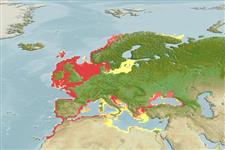
Atlantic Ocean: Trondheim to Morocco. Also known from the Mediterranean including Black Sea and the Azov Sea (Ref. 57814).
Chiều dài lúc trưởng thành đầu tiên / Bộ gần gũi / Khối lượng (Trọng lượng) / Tuổi
Chín muồi sinh dục: Lm 3.8, range 3 - ? cm
Max length : 7.9 cm TL con đực/không giới tính; (Ref. 26260); Tuổi cực đại được báo cáo: 1.00 các năm (Ref. 232)
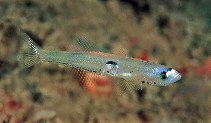
Các tia vây lưng cứng (tổng cộng) : 4 - 6; Các vây lưng mềm (tổng cộng) : 11 - 13; Tia cứng vây hậu môn: 1; Tia mềm vây hậu môn: 11 - 15. Transparent body, more or less reddish, with chromatophores along bases of median fins and on head. Vertebrae 26-28 (Ref. 232). Males with longer dorsal and anal fins than females (Ref. 35388).
Body shape (shape guide): elongated.
Benthic and free swimming (Ref. 92840). A neotenic, pelagic species inhabiting inshore and estuarine waters, over sand, mud and eel-grass (Ref. 4343). Adults feed on zooplankton, especially copepods, cirripede larvae and mysids (Ref. 4343). They spawn in summer in empty bivalve shells (Ref. 35388). Probably migrate to deeper water to spawn during summer (Ref. 57814). Adults die after breeding (Ref. 4696) which does not qualify as a manifestation of semelparity but abbreviate iteroparity according to a recent study (Ref. 81039). Eggs are pear-shaped (Ref. 4696).
Single spawner, all oocytes in the ovaries grow at a similar rate (Ref. 57814). However, a recent study showed that this species breeds at least twice during its short lifespan with batches of oocytes at different vittelogenic stages in the ovary (Ref. 81039). Reproduction is of the abbreviate iteroparous type with more than one spawning per reproductive season (in spring and summer in older females, in summer and autumn in the yougner ones) (Ref. 81039).
Maugé, L.A., 1986. Gobiidae. p. 358-388. In J. Daget, J.-P. Gosse and D.F.E. Thys van den Audenaerde (eds.) Check-list of the freshwater fishes of Africa (CLOFFA). ISNB, Brussels; MRAC, Tervuren; and ORSTOM, Paris. Vol. 2. (Ref. 4343)
Tình trạng Sách đỏ IUCN (Ref. 130435: Version 2025-2 (Global))
Mối đe dọa đối với con người
Harmless
Sử dụng của con người
Các nghề cá: tính thương mại
Các công cụ
Báo cáo đặc biệt
Tải xuống XML
Các nguồn internet
Ước tính dựa trên mô hình
Nhiệt độ ưa thích (Tài liệu tham khảo
123201): 7.6 - 18.6, mean 10.8 °C (based on 1452 cells).
Chỉ số đa dạng phát sinh loài (Tài liệu tham khảo
82804): PD
50 = 1.0000 [Uniqueness, from 0.5 = low to 2.0 = high].
Bayesian length-weight: a=0.00575 (0.00506 - 0.00654), b=3.09 (3.05 - 3.13), in cm total length, based on LWR estimates for this species (Ref.
93245).
Mức dinh dưỡng (Tài liệu tham khảo
69278): 3.2 ±0.2 se; based on diet studies.
Thích nghi nhanh (Tài liệu tham khảo
120179): Chiêù cao, thời gian nhân đôi của chủng quần tối thiểu là dưới 15 tháng (K>0.3; tm=1; tmax=1; Fec = 935).
Sự dễ bị tổn thương của nghề đánh cá (Ref.
59153): Low vulnerability (12 of 100).
🛈
Chất dinh dưỡng (Ref.
124155): Calcium = 395 [175, 1,059] mg/100g; Iron = 2.75 [1.16, 5.97] mg/100g; Protein = 18.4 [16.2, 20.3] %; Omega3 = 0.294 [0.105, 0.828] g/100g; Selenium = 29.2 [9.5, 91.1] μg/100g; VitaminA = 9.18 [1.88, 40.11] μg/100g; Zinc = 2.41 [1.43, 3.95] mg/100g (wet weight);