>
Scombriformes (Mackerels) >
Stromateidae (Butterfishes)
Etymology: Peprilus: Greek, peprilos, paprax, certain fish from Tracia.
Eponymy: Professor Dr Charles Earle Burt (1904–1963) was a herpetologist. [...] (Ref. 128868), visit book page.
More on author: Fowler.
Milieu: milieu / Klimaatzone / Diepte / verspreidingsgebied
Ecologie
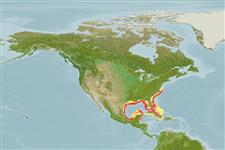
marien benthopelagisch; diepte 2 - 275 m (Ref. 53006), usually 155 - 225 m (Ref. 53006). Subtropical; 39°N - 17°N, 99°W - 73°W
Western Atlantic: entire Gulf of Mexico, from Tampa region in Florida, USA to Yucatan in Mexico; also in Virginia to northeastern Florida, USA (but possibly representing P. tricanthus instead, Ref. 53006).
Lengte bij maturiteit / Grootte / Gewicht / Leeftijd
Maturiteit: Lm 13.0, range 10 - 16 cm
Max length : 25.0 cm TL mannelijk / geslacht onbekend; (Ref. 7251)
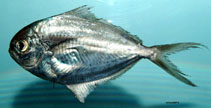
This species is distinguished by the following characters: body oval, deep (its depth less than 2.5 times in total length) and strongly compressed; eye surrounded by a small area of adipose tissue; snout short and blunt, lower jaw projecting somewhat beyond upper; mouth small, tip of maxillary not reaching below eye margin; teeth in jaws very small, in one row while those in the upper jaw flattened and with 3 tiny cusps; dorsal and anal fin bases very long (about equal in length), the anterior fin rays elevated, but fins not falcate, and both fins preceded by 3 short, weak, spines; caudal fin deeply forked; pectoral fins long (longer than head) and pointed; pelvic fins absent; distinct series of 17 to 25 pores along anterior half of body under the dorsal fin; lateral line high, following dorsal profile; scales small, present also on cheeks; caudal vertebrae 16 to 18; body color pale blue above, silvery below (fading after death), no spots (Ref. 53006).
Body shape (shape guide): short and / or deep.
A pelagic fish forming large loose schools across the continental shelf over sand/mud bottoms; depth range from 2 to 275 m at least, but most abundant at 155 to 225 m; found near the bottom during the day and migrating into the water column at night. Juveniles often found under floating weeds and with jellyfish. Adults feed on jellyfish, small fish, crustaceans, and worms; the juveniles are plankton and jellyfish feeders. Mature within 1 year and rarely lives past 2; spawning takes place at discrete intervals twice a year slightly offshore. Highly esteemed for food, marketed fresh and frozen; caught mainly with otter trawls (Ref. 53006).
Levenscyclus en paargedrag
Maturiteit | Voortplanting | Paaien | Eieren | Fecunditeit | Larven
Robins, C.R. and G.C. Ray, 1986. A field guide to Atlantic coast fishes of North America. Houghton Mifflin Company, Boston, U.S.A. 354 p. (Ref. 7251)
Status op de Rode Lijst van het IUCN (Ref. 130435: Version 2025-2 (Global))
Gevaar voor de mens
Harmless
Gebruik door de mens
Visserij: commercieel
Tools
Speciale rapporten
Download XML
Internetbronnen
Schattingen op basis van modellen
Gewenste temperatuur (Ref.
123201): 14.7 - 22.3, mean 18.1 °C (based on 26 cells).
Fylogenetische diversiteitsindex (Ref.
82804): PD
50 = 0.5020 [Uniqueness, from 0.5 = low to 2.0 = high].
Bayesian length-weight: a=0.01380 (0.00751 - 0.02539), b=3.01 (2.85 - 3.17), in cm total length, based on LWR estimates for this species & Genus-body shape (Ref.
93245).
Trofisch niveau (Ref.
69278): 4.0 ±0.28 se; based on food items.
Generation time: 0.7 ( na - na) years. Estimated as median ln(3)/K based on 2
growth studies.
Weerstandsvermogen (Ref.
120179): Hoog, minimale populatieverdubbelingstijd minder dan 15 maanden (tm=1; tmax=2; K>0.3).
Kwetsbaarheid van de visserij (Ref.
59153): Low vulnerability (12 of 100).
🛈