>
Perciformes/Scorpaenoidei (Scorpionfishes) >
Sebastidae (Rockfishes, rockcods and thornyheads) > Sebastinae
Etymology: Sebastes: Greek, sebastes = august, venerable (Ref. 45335).
Eponymy: John Pease Babcock (1855–1936) was a fisheries expert, civil servant, conservationist and author, who helped to establish the scientific and institutional underpinnings of fisheries conservation in British Columbia although he had no formal [...] (Ref. 128868), visit book page.
Environnement : milieu / zone climatique / profondeur / gamme de distribution
Écologie
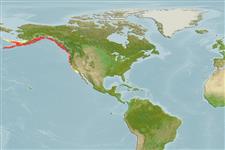
marin démersal; profondeur 49 - 625 m (Ref. 6793). Temperate; 66°N - 32°N, 179°W - 116°W
North Pacific: Zhemchug Canyon in the Bering Sea and Amchitka Island in the Aleutian chain to San Diego, California, USA.
Longueur à la première maturité / Taille / Poids / Âge
Maturité: Lm 38.5, range 34 - ? cm
Max length : 64.0 cm TL mâle / non sexé; (Ref. 2850); poids max. publié: 4.4 kg (Ref. 40637); âge max. reporté: 106 années (Ref. 39247)
Description synthétique
Clés d'identification | Morphologie | Morphométrie
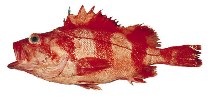
Épines dorsales (Total) : 13; Rayons mous dorsaux (Total) : 13 - 15; Épines anales: 3; Rayons mous anaux: 6 - 7. Head spines strong to moderate - nasal, preocular, supraocular, postocular, tympanic (may be absent), coronal and parietal spines present, nuchals usually absent (Ref. 27437). 2nd anal fin spine longer than 3rd (Ref. 27436). Posterior margin of caudal fin almost straight (Ref. 6885). Light pink to red with 4 darker red vertical bars on body (the first extending from front of dorsal to the base of pectoral, the last found on the caudal peduncle), the bars more prominent on smaller fish; 1 dark bar radiating from each eye (Ref. 27436).
Body shape (shape guide): fusiform / normal.
Found on soft bottoms (Ref. 2850). Viviparous (Ref. 34817).
Eschmeyer, W.N., E.S. Herald and H. Hammann, 1983. A field guide to Pacific coast fishes of North America. Boston (MA, USA): Houghton Mifflin Company. xii+336 p. (Ref. 2850)
Statut dans la liste rouge de l'IUCN (Ref. 130435: Version 2025-2 (Global))
Menace pour l'homme
Harmless
Utilisations par l'homme
Pêcheries: intérêt commercial mineur
Outils
Articles particuliers
Télécharger en XML
Sources Internet
Estimations basées sur des modèles
Température préférée (Réf.
123201): 3.7 - 7.1, mean 5.5 °C (based on 149 cells).
Indice de diversité phylogénétique (Réf.
82804): PD
50 = 0.5000 [Uniqueness, from 0.5 = low to 2.0 = high].
Bayesian length-weight: a=0.01000 (0.00490 - 0.02040), b=3.09 (2.92 - 3.26), in cm total length, based on LWR estimates for this Genus-body shape (Ref.
93245).
Niveau trophique (Réf.
69278): 3.8 ±0.5 se; based on size and trophs of closest relatives
Résilience (Réf.
120179): Très faible, temps minimum de doublement de population supérieur à 14 ans (tmax=106).
Vulnérabilité de la pêche (Ref.
59153): Moderate to high vulnerability (46 of 100).
🛈