>
Eupercaria/misc (Various families in series Eupercaria) >
Nemipteridae (Threadfin breams, Whiptail breams)
Etymology: Nemipterus: Greek, nema, -atos = filament + Greek, pteron = wing, fin (Ref. 45335).
Ambiente: milieu / zona climatica / distribuzione batimetrica / gamma di distribuzione
Ecologia
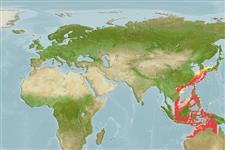
marino demersale; non migratori; distribuzione batimetrica 1 - 220 m (Ref. 9785), usually 18 - 33 m (Ref. 54679). Tropical; 39°N - 20°S, 106°E - 140°E (Ref. 54679)
Western Pacific: southern Japan to northwestern Australia and the Arafura Sea.
Lunghezza alla prima maturità / Dimensione / Peso / Età
Maturità: Lm ?, range 15 - ? cm
Max length : 35.0 cm SL maschio/sesso non determinato; (Ref. 3810); common length : 23.0 cm SL maschio/sesso non determinato; (Ref. 3810)
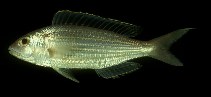
Spine dorsali (totale) : 10; Raggi dorsali molli (totale) : 9; Spine anali: 3; Raggi anali molli: 8. Suborbital spine absent. Preopercle with 3 transverse scale rows. Pectoral and pelvic fins long, reaching to between level of anus and origin of anal fin. Upper lobe of caudal fin produced to form a trailing filament. A line drawn up from the posterior edge of suborbital reaching the dorsal profile 5 to 7 scale rows before origin of dorsal fin. Axillary scale present. Body color pink, paler below. Head pink, a yellow stripe from upper lip extending to antero-ventral margin of eye. Two faint yellow bars across cheek sometimes present. Pelvic fins with yellow stripes.
Body shape (shape guide): fusiform / normal; Cross section: oval.
Inhabits muddy or sandy bottoms. Young fish generally occur in shallower water between 18 and 33 m. Feeds on crustaceans, fish and cephalopods. One of the most important commercial fish in the East China Sea and northern South China Sea. May be made into fish balls (Ref. 4931).
This species is a rudimentary hermaphrodite in which males have functional testes with rudimentary ovarian portions that remain throughout their life.
Russell, B.C., 1990. FAO Species Catalogue. Vol. 12. Nemipterid fishes of the world. (Threadfin breams, whiptail breams, monocle breams, dwarf monocle breams, and coral breams). Family Nemipteridae. An annotated and illustrated catalogue of nemipterid species known to date. FAO Fish. Synop. 125(12):149p. Rome: FAO. (Ref. 3810)
Stato della Lista Rossa IUCN (Ref. 130435: Version 2025-2 (Global))
Minaccia per l'uomo
Harmless
Usi umani
Pesca: commerciale; Pesce da pesca sportiva: si
Strumenti
Rapporti speciali
Scarica XML
Fonti Internet
Stime basate su modelli
Temperatura preferita (Fonte Biblio.
123201): 24 - 29, mean 28.1 °C (based on 352 cells).
Indice di diversità filogenetica (Fonte Biblio.
82804): PD
50 = 0.5000 [Uniqueness, from 0.5 = low to 2.0 = high].
Bayesian length-weight: a=0.01413 (0.01187 - 0.01681), b=2.96 (2.93 - 2.99), in cm total length, based on LWR estimates for this species (Ref.
93245).
Livello trofico (Fonte Biblio.
69278): 4.0 ±0.57 se; based on food items.
Generation time: 3.2 (2.5 - 3.7) years. Estimated as median ln(3)/K based on 14
growth studies.
Resilienza (Fonte Biblio.
120179): Medio, tempo minimo di raddoppiamento della popolazione 1.4 - 4.4 anni (K=0.24-0.45; Fec=2,000).
Prior r = 0.91, 95% CL = 0.60 - 1.37, Based on 2 data-limited stock assessments.
Vulnerabilità della pesca (Ref.
59153): Low to moderate vulnerability (35 of 100).
🛈
Vulnerabilità climatica (Ref.
125649): Moderate to high vulnerability (48 of 100).
🛈
Nutrienti (Ref.
124155): Calcium = 353 [80, 674] mg/100g; Iron = 1.1 [0.4, 3.1] mg/100g; Protein = 18 [16, 20] %; Omega3 = 0.298 [0.148, 0.650] g/100g; Selenium = 49.2 [19.9, 137.2] μg/100g; VitaminA = 9.82 [2.30, 54.41] μg/100g; Zinc = 0.707 [0.413, 2.373] mg/100g (wet weight); based on
nutrient studies.