>
Perciformes/Scorpaenoidei (Scorpionfishes) >
Sebastidae (Rockfishes, rockcods and thornyheads) > Sebastinae
Etymology: Sebastes: Greek, sebastes = august, venerable (Ref. 45335).
Eponymy: Frank Cramer (1861–1948) was an ichthyologist and biologist at Stanford University. [...] (Ref. 128868), visit book page.
More on author: Jordan.
Environnement : milieu / zone climatique / profondeur / gamme de distribution
Écologie
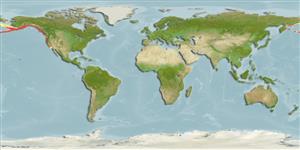
marin bathydémersal; profondeur 25 - 600 m (Ref. 6793), usually 76 - ? m (Ref. 2850). Temperate; 70°N - 32°N, 162°E - 116°W
Northeast Pacific: southeast of Zhemchug Canyon in the Bering Sea to Santa Catalina Island, California, USA.
Longueur à la première maturité / Taille / Poids / Âge
Maturité: Lm 34.2, range 24 - ? cm
Max length : 58.0 cm TL mâle / non sexé; (Ref. 27437); âge max. reporté: 105 années (Ref. 55644)
Description synthétique
Clés d'identification | Morphologie | Morphométrie
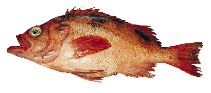
Épines dorsales (Total) : 13; Rayons mous dorsaux (Total) : 12 - 14; Épines anales: 3; Rayons mous anaux: 5 - 7. Head spines strong to moderate - nasal, preocular, supraocular, postocular, tympanic, parietal and nuchal spines present, coronal spines absent; second anal fin spine shorter than third (Ref. 27437). Caudal fin moderately indented (Ref. 6885). Deep bodied, pinkish with 4 or 5 dark patches on back, 3 under spinous dorsal, 1 under caudal peduncle (Ref. 27437).
Body shape (shape guide): fusiform / normal.
A deep-water species found on soft bottoms (Ref. 2850). Viviparous (Ref. 34817). Anterolateral glandular grooves with venom gland (Ref. 57406).
Allen, M.J. and G.B. Smith, 1988. Atlas and zoogeography of common fishes in the Bering Sea and northeastern Pacific. NOAA Tech. Rep. NMFS 66, 151 p. (Ref. 6793)
Statut dans la liste rouge de l'IUCN (Ref. 130435: Version 2025-2 (Global))
Utilisations par l'homme
Pêcheries: commercial; pêche sportive: oui
Outils
Articles particuliers
Télécharger en XML
Sources Internet
Estimations basées sur des modèles
Température préférée (Réf.
123201): 1 - 7.5, mean 4.7 °C (based on 336 cells).
Indice de diversité phylogénétique (Réf.
82804): PD
50 = 0.5000 [Uniqueness, from 0.5 = low to 2.0 = high].
Bayesian length-weight: a=0.01000 (0.00490 - 0.02040), b=3.09 (2.92 - 3.26), in cm total length, based on LWR estimates for this Genus-body shape (Ref.
93245).
Niveau trophique (Réf.
69278): 3.8 ±0.5 se; based on size and trophs of closest relatives
Résilience (Réf.
120179): Très faible, temps minimum de doublement de population supérieur à 14 ans (K=0.09(?); tm=5.1-8.4; tmax=105; Fec=19,815).
Prior r = 0.09, 95% CL = 0.06 - 0.14, Based on 2 full stock assessments.
Vulnérabilité de la pêche (Ref.
59153): High vulnerability (64 of 100).
🛈
Nutriments (Ref.
124155): Calcium = 19 [8, 60] mg/100g; Iron = 0.229 [0.097, 0.540] mg/100g; Protein = 17.9 [16.7, 19.0] %; Omega3 = 1.23 [0.53, 2.97] g/100g; Selenium = 43.6 [17.2, 124.2] μg/100g; VitaminA = 24 [8, 78] μg/100g; Zinc = 0.378 [0.200, 0.665] mg/100g (wet weight);